
The Pronghorn Lesson: Recovery Requires Room to Move
Trans-Pecos pronghorn rebounded through translocation, habitat work and restored connectivity. Their recovery shows why wildlife management fails when it isolates one predator from the landscape around it. Byline: Pitchstone Waters

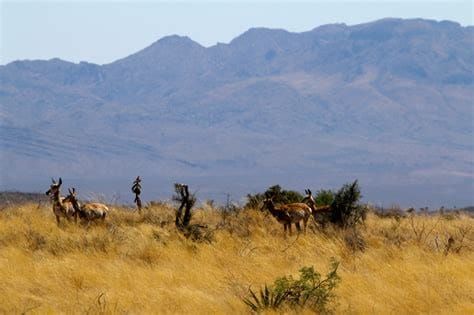
When a wildlife population falls, the public conversation usually looks for a culprit.
Predators are visible. Drought is familiar. Disease can be tested. A fence is just part of the scenery.
But the pronghorn of Far West Texas have been teaching a harder and more useful lesson: populations rarely rise or fall for one reason. Animals respond to an entire system—rainfall, forage, parasites, cover, movement barriers, roads, predators and the condition of the individual animal when pressure arrives.
The restoration of Trans-Pecos pronghorn is therefore more than a wildlife success story. It is a case study in how management improves when we stop asking which single factor is responsible and start asking how the factors work together.
A population in trouble
Pronghorn once occupied Texas in enormous numbers. By the early 2010s, however, the Trans-Pecos population had fallen to a historic low. The Borderlands Research Institute reported that only about 1,200 animals remained in 2012.
Research during the decline found no single explanation.
Drought reduced the green forbs that pronghorn depend on. Does entered the fawning season in poor condition. Sparse vegetation left newborn fawns with little concealment. Animals concentrated around remaining water and forage, increasing exposure to parasites. Coyotes and bobcats took fawns, especially when alternative prey was scarce.
Net-wire fencing added another pressure. Pronghorn are built for speed across open country, but they generally prefer to crawl under fences rather than jump them. A fence that cattle barely notice can divide a pronghorn’s usable habitat, prevent escape from predators and block access to forage that may have greened up only a few miles away.
Each problem strengthened the others.
A weak fawn is more vulnerable to predation. A doe blocked from better forage is less able to produce and raise a strong fawn. Animals confined by fencing cannot respond normally when drought shifts food across the landscape. Concentration around limited resources can increase parasite exposure.
Calling the decline a predator problem, a drought problem or a disease problem would have captured part of the truth while missing the system.
What recovery required
The response was correspondingly broad.
Texas Parks and Wildlife Department, the Borderlands Research Institute, landowners and other partners translocated pronghorn from healthier populations. They restored grasslands, modified or replaced restrictive fencing, studied survival and movement with GPS collars and used targeted predator management in selected herd units.
The results were substantial. A 2024 Borderlands Research Institute report said the Trans-Pecos population had increased from roughly 1,200 animals in 2012 to 6,865. Six translocations helped rebuild numbers, but the report placed particular emphasis on habitat connectivity.
Collared animals showed researchers how strongly net-wire fences restricted movement. Landowners and managers responded by modifying or replacing fences across important habitat in the Marfa Plateau and Marathon Basin. Later collar data showed pronghorn moving across much larger areas.
That is what successful management should look like: observe a limiting condition, change it and measure the animal’s response.
The work is continuing. In a 2025 request for new research, TPWD described spending approximately $2.8 million during the preceding year on grassland restoration and restrictive-fence work, with another $2 million planned over the following two years. It also reported spending about $134,000 on coyote removal before the 2025 fawning season in most Trans-Pecos herd units.
Those numbers reveal an important distinction. Predator control may provide a timely benefit, but the larger investment is going into the landscape that pronghorn must use every day.
A coyote can be removed. A fragmented range has to be repaired.
Follow the food
Pronghorn are especially dependent on mobility because much of their diet consists of forbs—nutritious flowering plants whose abundance can change rapidly with rainfall.
A storm may turn one portion of the range green while leaving another dry. Survival depends partly on the animal’s ability to find and reach that temporary resource.
Researchers studying the Marfa Plateau found that pronghorn followed green vegetation as conditions changed. Interior fence modifications improved movement, but highways and their right-of-way fencing still divided the plateau into large quadrants. Collared animals rarely crossed between them.
This does not mean every road requires an expensive wildlife overpass. The same research identified different solutions for different locations. Some highway segments may justify crossing structures. Elsewhere, wide setbacks, low traffic and pronghorn-friendly fencing may already provide sufficient permeability.
That is another useful lesson: infrastructure should be judged by its demonstrated effect, not by its label. A road, fence or energy site is not automatically harmless or automatically catastrophic. Map the movements. Measure the response. Fix the barrier that is actually limiting the animals.
Recent USGS work in the Chihuahuan Desert of New Mexico follows the same logic. Researchers are tracking how individual fences influence pronghorn movement so limited restoration dollars can be directed toward the barriers and corridors that matter most.
Predation in context
None of this means predation is imaginary or unimportant.
Coyotes and bobcats kill pronghorn fawns. When recruitment is poor and a population is small, strategically timed predator removal may help more young animals survive. Texas continues to use that tool.
But predation does not occur separately from habitat.
Fawns born into good cover are harder to find. Fawns born at healthy weights are better able to survive. When does have adequate nutrition, births can occur within a tighter period, limiting the time predators have access to vulnerable newborns. Healthy populations of rabbits and rodents may also give predators alternatives.
Removing predators without addressing those conditions can create an annual obligation rather than a durable recovery.
The right question is therefore not whether predators matter. They do.
The question is what made the population vulnerable to predation, and which combination of actions produces the greatest lasting improvement.
Management that learns
TPWD is now seeking a Texas-specific integrated population model using survival, movement and environmental data from the Panhandle and Trans-Pecos. The stated goal is to evaluate climatic, landscape, predator and management scenarios together.
That may sound technical, but the principle is straightforward.
Count more than animals. Measure fawn survival, doe survival, rainfall, vegetation, barriers, movements and the results of each intervention. Use those measurements to decide when translocation is justified, where fence work will matter, and whether predator removal is buying a temporary increase or contributing to a self-sustaining herd.
The pronghorn recovery already demonstrates the value of that approach. Numbers improved because people worked across property lines, combined tools and allowed new evidence to change the work.
The job is not finished. Rainfall will remain erratic. Highways still interrupt movement. Habitat changes continually, and managers acknowledge that important questions about fawn survival remain unanswered.
But the direction is clear.
Wildlife management is strongest when it treats the animal and its landscape as one system. Restore the forage. Make room for movement. Remove the barrier. Use translocation and predator control where the evidence shows they help. Then keep measuring.
Pronghorn do not need one more argument about which single thing matters most.
They need room to find what they need next.
Sources
- Borderlands Research Institute: 2024 Big Game Research Report
- Texas Parks and Wildlife Department: Developing an Integrated Population Model for Pronghorn in Texas
- Borderlands Research Institute: Pronghorn Movements Following Restoration
- Texas Parks and Wildlife Department: Pronghorn Antelope in the Trans-Pecos
- USGS: American Pronghorn Movements in the Chihuahuan Desert
Editorial note: This is a Pitchstone Waters institutional editorial developed with AI assistance under human direction. It draws on Chris Gill’s published work and Pitchstone’s documented principles, but it is not presented as a new article written by Chris.
