What a Cow Pie Does After the Herd Moves On
A cow pie can become recycled fertility, forage-fouling residue or insect habitat. Learn what controls decomposition after cattle leave.

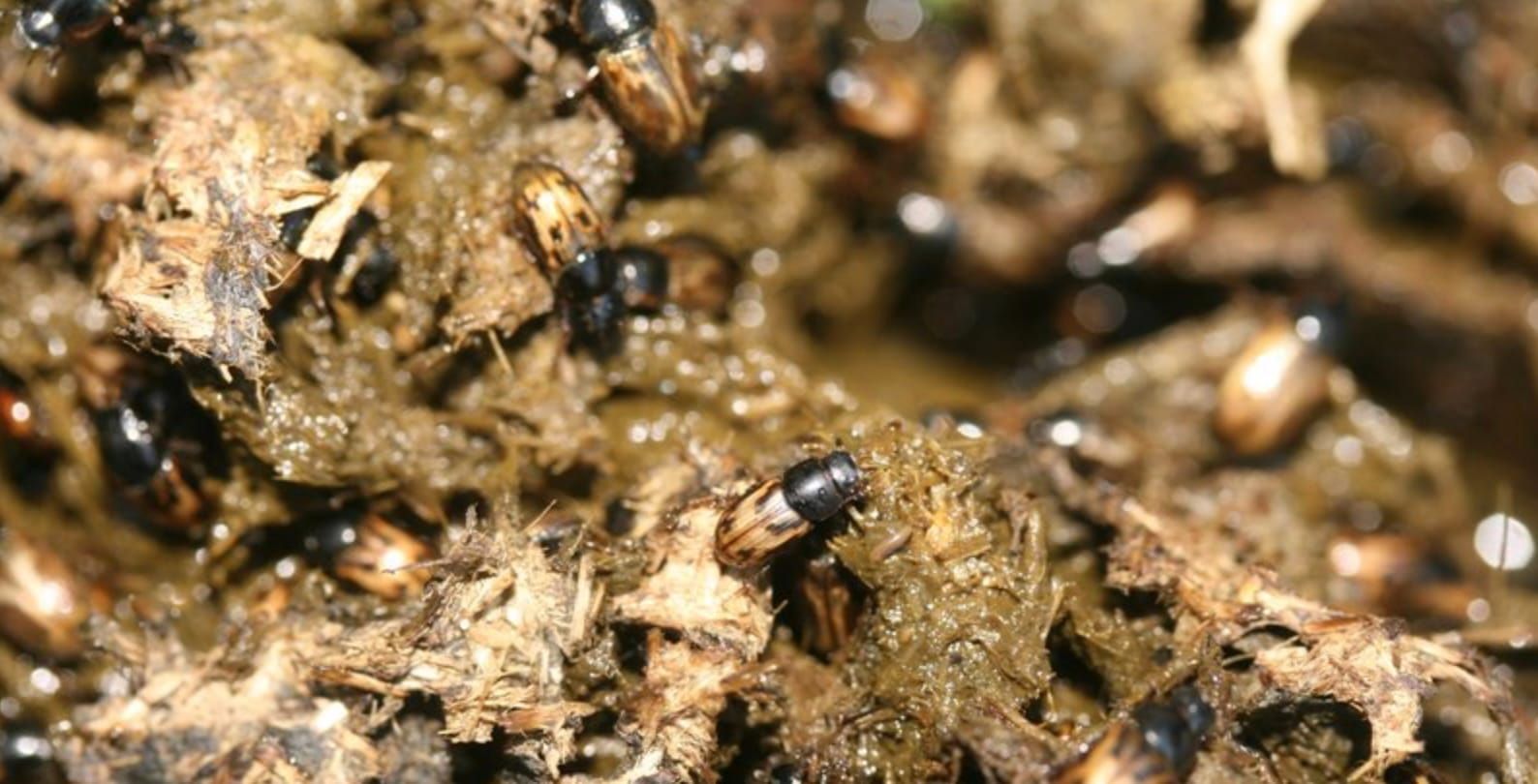
After cattle leave a pasture, their dung remains as hundreds of small experiments. One pat is perforated and pulled into the soil. Another dries into a hard plate. A third becomes a nursery for flies.
All three began with manure. What happens next depends on moisture, temperature, insects, soil organisms, livestock treatments and how long the pasture has to respond.
Manure is a transfer, not an endpoint
Cattle gather plant material across a grazing area and return part of it in concentrated patches. Those patches contain organic matter and nutrients, but deposition alone does not make them available to plants.
Dung must be broken, buried, consumed and mixed. Microbes perform much of the chemical work. Beetles, flies, earthworms and other organisms change its physical structure and move material into contact with soil.
Pitchstone’s 2022 archive article The Magic of Cow Manure recognized that manure can contribute to soil building. The useful update is to remove the word “automatic.” Nutrient cycling is an ecological process, not an intrinsic property of a cow pie.
Different insects perform different jobs
“Dung beetle” describes many species with different strategies. Some live and reproduce within the pat. Some tunnel below it and carry dung underground. Others form balls and move them away.
These activities can open the pat to air and water, reduce the time it covers forage and place organic material below the surface. Predatory beetles and parasitoid wasps can also attack fly larvae or pupae. The University of Minnesota Extension notes that predatory insects form one part of fly management while cautioning that their population-level effects vary and that broad insecticide exposure can also harm beneficial organisms.
Dung is therefore habitat as well as waste. The community that arrives helps determine whether the pat is rapidly incorporated, slowly weathered or dominated by pest species.
Livestock medicine can reach the pasture
Some products given to livestock remain biologically active after excretion. The effect depends on the compound, formulation, dose, timing and sensitivity of local organisms. This does not mean animal-health treatments should be withheld when they are needed. It means pasture ecology belongs in the treatment decision.
Ask the veterinarian what evidence supports the treatment, which animals need it, how the product is excreted and whether a targeted approach can meet the health objective. A parasite-control program that preserves efficacy and avoids unnecessary exposure serves both livestock and the organisms working the dung.
The correct choice cannot be reduced to “chemical” versus “natural.” Untreated parasites impose real welfare and production costs. Routine treatment without diagnosis can create other costs, including resistance. Evidence and timing matter.
Read the pats, not the slogan
A simple field check can turn the subject into observations:
- Mark several fresh pats in different parts of the pasture.
- Revisit them after a few days, two weeks and a month.
- Note holes, tunnels, broken edges, soil casts, larvae and vegetation response.
- Compare shaded and exposed locations and record rainfall.
- Compare periods following different herd treatments, without drawing conclusions from a single pat.
Fast disappearance is not always the sole objective. Weather can physically break manure apart without much incorporation, while insects may be active beneath a pat that looks intact. Dig carefully under a subset and photograph the same locations.
Also map distribution. Manure concentrated around water and shade signals an animal-distribution issue even if every pat decomposes efficiently. Nutrients returned to one small area are nutrients removed from another.
The herd has left; management has not
The value of manure depends on what happens after deposition: whether organisms can work, whether plants recover and whether nutrients are spread across the ground that produced them.
A cow pie is not proof of regeneration. It is an opportunity for cycling. The difference is visible in the insects, soil and vegetation that take over after the herd moves on.
Editorial note: This is a Pitchstone Waters institutional editorial developed with AI assistance under human direction. It draws on Chris Gill’s published work and Pitchstone’s documented principles, but it is not presented as a new article written by Chris.

