Open Letter to America’s Public Lands Ranching Community
A guest open letter from Wild Horse Fire Brigade's William E. Simpson II urges ranchers to back a limited pilot relocating wild horses to remote wilderness and forest land. Read the proposal, and our notes on what is established and what is still claimed.

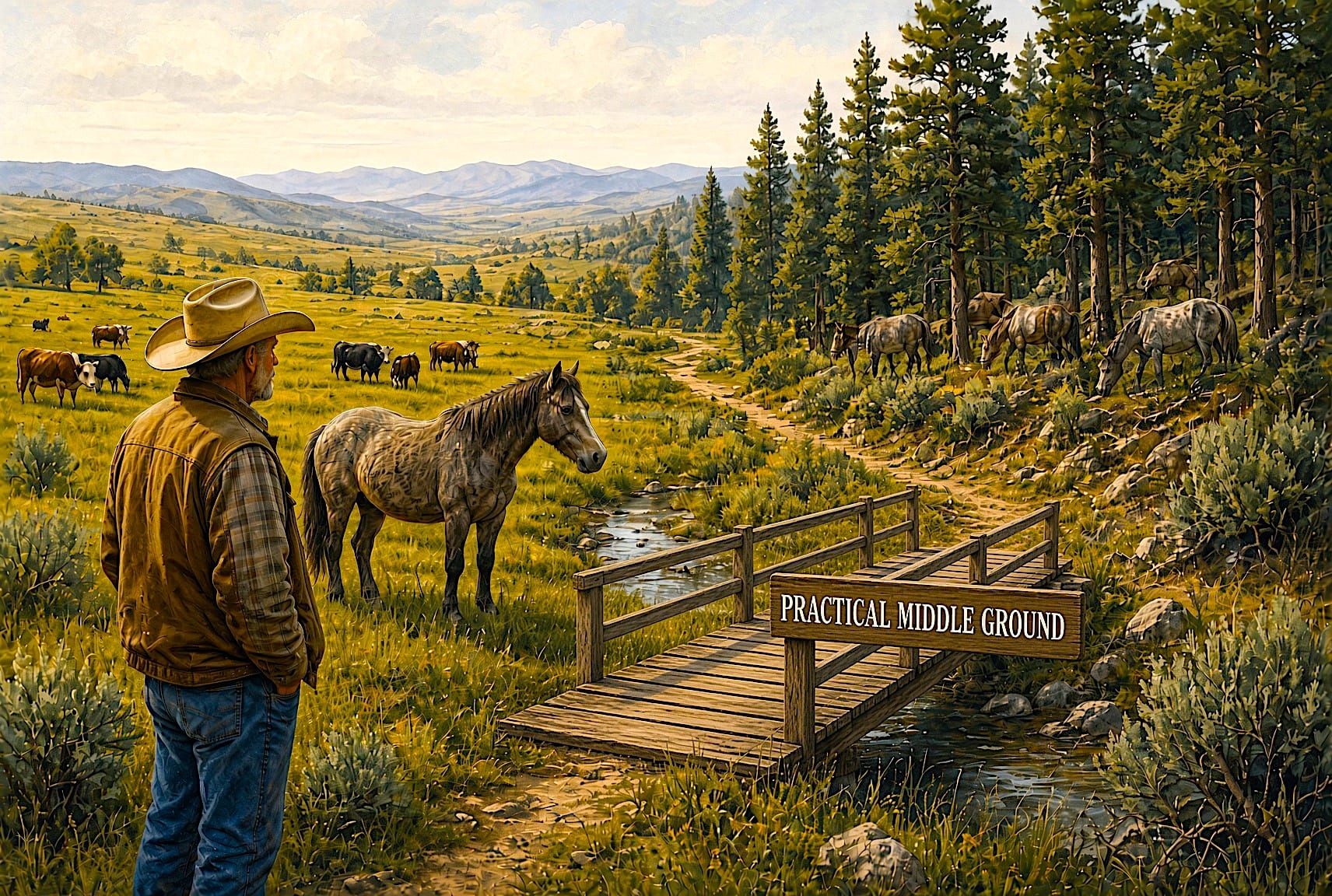
The debate over wild horses and livestock grazing on America's public lands has gone on for decades, with plenty of disagreement and very little resolution. Too often, the discussion becomes a contest between competing interests rather than a serious examination of what is best for the land.
William Simpson raises an interesting possibility: what if ranchers and wild-horse advocates could find common ground in an approach that benefits both? His proposal deserves consideration, not because every claim has been proven or every obstacle resolved, but because it asks whether there might be a better way to manage these landscapes.
At Pitchstone Waters, we believe that healthy land is the ultimate measure of good management. Whether the subject is livestock, wildlife, wildfire, or public policy, the important questions are the same: What does the evidence tell us? What happens on the ground? And are we willing to learn from the results?
Those are questions worth asking, regardless of where one stands on wild horses.
By William E. Simpson II, Rancher & Executive Director, Wild Horse Fire Brigade - November 6, 2026
To the Ranching Industry:
The 2026 midterm results have altered the political landscape on public lands. With Democratic majorities in both chambers of Congress, the environment for traditional public-lands grazing is less favorable than it has been in recent years.
Democrats have long been skeptical of below-market grazing fees, predator compensation programs, and other taxpayer supports that many operators have relied upon. Those supports are now under greater scrutiny, and the window to shape outcomes through practical, on-the-ground solutions is narrowing.
Ranchers already face real economic pressure from imported beef, competition for water, and the expansion of solar development on public lands. Order 3454 accelerated livestock expansion and wild-horse reductions in a manner that many voters viewed as prioritizing a narrow set of commercial interests. The political cost of that approach is now clear.
Continuing to defend the status quo against a Congress that is less sympathetic risks further restrictions, higher costs, and renewed conflict.
A different path exists.
For more than twelve years, the Wild Horse Fire Brigade has demonstrated a practical alternative on the ground. The plan relocates wild horses as free-ranging keystone grazers into critical wilderness and remote forest areas where they reduce fine fuels at essentially no cost to taxpayers. At the same time, it reduces competition on productive grazing allotments, easing pressure on livestock operators while conserving wild horses in a manner consistent with existing law.
The benefits of the Wild Horse Fire Brigade PLAN are concrete and measurable:
- Reduced competition for forage: By moving wild horses off productive allotments into remote wilderness and forest areas, the plan increases available forage for livestock on the lands ranchers actually use. This eases pressure without eliminating grazing.
- Taxpayer cost savings: The current system spends tens to hundreds of millions of dollars annually on long-term holding, feedlot contracts, and fertility-control programs (including PZP). Relocating horses as free-ranging grazers eliminates most of these holding and processing costs. Independent insurance analysis has examined the plan's potential to cut these expenditures substantially.
- Wildfire fuel reduction and public safety: Horses naturally reduce fine fuels (grasses and brush) that drive catastrophic fire. During the 2018 Klamathon Fire, observed grazing by the studied herd helped create natural firebreaks across thousands of acres. Peer-reviewed research (including UCLA Science Advances work) documents that wildfire smoke causes tens of thousands of premature deaths annually in the United States and substantial economic damage. Reducing fuels at the landscape scale lowers that risk for rural communities.
- Legal and ecological compliance: The approach works within existing law, maintains genetically intact wild horse populations, and supports wildlife habitat rather than treating horses solely as competitors.
- End to unnecessary conflict: It replaces decades of roundups, litigation, and political fighting with a management model that serves ranchers, wildlife interests, and taxpayers simultaneously.
More information: wildhorsefirebrigade.org/benefitswhfb
This is not a zero-sum proposal.
It is a middle-ground approach that improves range conditions for livestock, lowers taxpayer costs, reduces wildfire risk, and ends a conflict that has produced little lasting benefit for either ranchers or wild-horse advocates. The plan is grounded in long-term on-the-ground observation of horse behavior and fuel reduction and has been reviewed by insurance analysts.
Keep in mind; we are not motivated by money - we are an all-volunteer nonprofit that is funded by donations from average Americans from all sides of the issues, who are tired of the wildfires and toxic smoke, the cruel management of protected wild horses, and the extreme waste of precious tax dollars.
We are seeking support from logically minded operators for a pilot implementation of the Wild Horse Fire Brigade plan on appropriate public lands. A limited, transparent pilot would allow the industry, agencies, and the public to evaluate results on forage availability, fuel reduction, wildlife outcomes, and costs before broader decisions are made by a new Congress. Waiting for others to impose a solution is no longer the safer course.
Time is no longer on the side of the status quo. Operators who recognize both the ecological realities on the range and the changed political environment have an opportunity to help shape a durable outcome that serves livestock interests, wildlife, and taxpayers. We invite constructive engagement and stand ready to brief any interested producers or associations on the details of the plan and a potential pilot.
Respectfully,
William E. Simpson II
Rancher · Wild Horse Researcher
Wild Horse Fire Brigade
William E. Simpson II is an ethologist living among and studying free-roaming American wild horses, and the author of a study on the behavioral ecology of wild horses, two published books and, by his count, more than 500 articles on wild horses, wildlife, wildfire and public-land management. [Bio to be confirmed by the author.]
What we checked
Pitchstone's notes. These are ours, not the author's.
- Order 3454 was signed Oct. 27, 2026. Interior says it directs agencies to identify more land for grazing, speed permit renewals and review suspended grazing use. Reporting also says it asks BLM to evaluate wild horse impacts and strategies to reach appropriate management levels.
- Costs: BLM reports about $153 million in program spending in fiscal 2024, with roughly $101 million for off-range holding. The letter's projected savings have not been published as a model.
- Law: BLM says it lacks authority to place wild horses in Wilderness Areas, citing Section 1339 of the 1971 Act. The author says the plan doesn't rely on that section: once BLM or the Forest Service declares horses excess, they can be transferred under a separate authority. BLM policy does allow transfers of excess horses to government agencies. We have not seen that authority used to place horses in Wilderness Areas.
- Wildfire smoke: A February 2026 Science Advances study estimates about 24,100 U.S. deaths a year from wildfire smoke (2006–2020). The UCLA Science Advances study covers California only: 52,500–55,700 deaths from 2008 to 2018.
- Klamathon Fire: The July 2018 fire burned 38,008 acres. The reported firebreaks come from the author's field observations; we found no independent after-action confirmation.
- Insurance analysis: We found a 2023 AM Best TV segment and a WHFB press release, but no published actuarial analysis of taxpayer savings.
Get Pitchstone Waters in your inbox
Pitchstone Waters is a free email publication on ranching, ecology and land stewardship. Subscribe to get our Tuesday email, with the questions that matter on the land and the evidence behind them.
Related reading
- Why Wild Horse Fire Brigade stands alone
- 'Rewilding' Horses Aims to Mitigate Wildfires, Reduce Insured Losses
- Grazing & Working Lands
