A Bat Colony Is Only as Healthy as the Country Around It
A cave can shelter hundreds of thousands of bats. It cannot feed them. Protecting a bat flight means protecting the insects, water and open country beyond the roost.


At sunset, the mouth of Carlsbad Cavern appears to exhale.
Brazilian free-tailed bats rise from the darkness, gather into a moving column and stream into the evening sky. The outflight can continue for hours. The National Park Service describes several hundred thousand bats leaving the cavern on summer nights, each headed into the surrounding country in search of insects.
The cave makes the spectacle possible. It gives the colony darkness, space, suitable temperatures and protection while the animals rest.
But the cave is only half the habitat.
A bat can roost underground and feed many miles away. If the land beyond the entrance stops producing insects, loses water or becomes difficult to cross, an undisturbed cave may still become an empty one.
Protecting a bat flight therefore requires more than protecting the hole in the ground. It requires protecting the system that feeds what lives inside it.
The roost is essential—and vulnerable
Carlsbad Caverns National Park supports 17 bat species. Its famous Brazilian, or Mexican, free-tailed bats return from spring through fall, joining seasonal movements that connect the American Southwest with wintering areas in Mexico.
Large colonies depend on a surprisingly small number of suitable roosts.
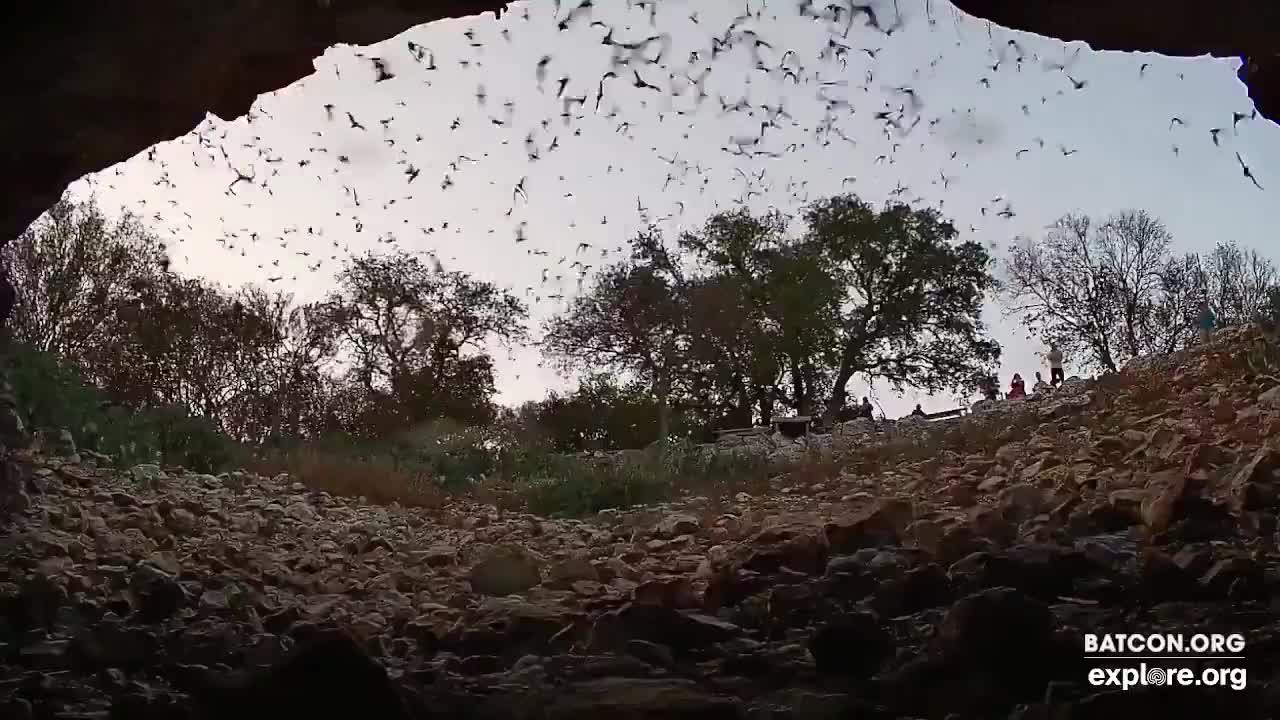
In Texas, Bracken Cave holds more than 15 million Mexican free-tailed bats. Other sites—including the Eckert James River Bat Cave, Frio Bat Cave and Old Tunnel—hold colonies measured in the millions. Bridges, mines, cliffs and buildings also provide important shelter.
These concentrations are one of the species’ strengths. Millions of animals can raise their young in warm, protected sites and emerge together to exploit insects across a large landscape.
Concentration is also a weakness.
A single destructive act, poorly timed construction project or repeated disturbance can affect an enormous number of animals. Texas Parks and Wildlife Department notes that females generally produce only one pup each year, so a damaged maternity colony cannot be replaced quickly.
The first rule is therefore simple: protect the roost.
Do not enter occupied caves or mines. Do not seal an active colony inside a building. Schedule repairs or exclusions outside maternity season and use qualified help. At public flight sites, follow restrictions on lights, photography and noise. The rules are not theater. Bats accustomed to darkness and quiet can change their behavior when exposed to sudden light and sound.
But protecting the roost is only the beginning.
The feeding ground is part of the colony
Every evening flight links the cave to farms, ranches, deserts, riparian corridors and towns.
The bats at Carlsbad Cavern are insectivores. So are the other bat species found in the park. Mexican free-tailed bats consume flying insects, including moths and beetles. Across Texas, colonies disperse into the night and turn a vast pulse of insects into energy for migration, pregnancy and growing pups.
This is often described as a service to agriculture, and it is. Research cited by Texas Parks and Wildlife Department found that Mexican free-tailed bats can reduce insecticide costs and crop losses in Texas farming country.
But the ecological relationship is broader than a dollar estimate.
Insects emerge from healthy soil, native vegetation, crops, creek bottoms and seasonal water. Their abundance changes with rainfall, temperature and land management. A bat colony is therefore connected to conditions far beyond the property containing its roost.
Heavy, indiscriminate pesticide use can reduce prey and expose bats to toxins. The loss of wetlands or stock-water access can remove drinking sites. Clearing riparian vegetation can simplify productive feeding corridors. Development around a cave may leave the roost physically intact while degrading the surrounding landscape that made it valuable.
A cave without feeding habitat is shelter without a pantry.
From the Pitchstone archive
Yellowstone Bats
Bats are among the most misunderstood—and necessary—mammal predators. See how food, water and suitable roosts support the 13 bat species found across Greater Yellowstone.
Read Yellowstone Bats →Migration enlarges the responsibility
Mexican free-tailed bats do not recognize state lines or national borders.
Many arrive in Texas and New Mexico in spring and return toward Mexico as colder weather approaches. The National Park Service notes that even the winter distribution of the Carlsbad bats remains incompletely understood. Biologists have verified use of several Mexican caves, but basic questions remain about routes, stopovers and the status of winter colonies.
That uncertainty matters.
A colony protected at its summer roost can still decline because of conditions encountered elsewhere. The relevant habitat may include hundreds of miles of airspace, feeding country and temporary shelter between seasonal destinations.
This is why local conservation and international cooperation are not competing ideas. Both are necessary. Protect the known roost while continuing to learn where the animals go next.
Management begins with restraint
Wildlife work is often discussed as if improvement always requires adding something: a structure, a treatment, a program or a new technology.
Bat conservation frequently begins by avoiding damage.
Keep people out of sensitive roosts. Preserve access to water. Retain native vegetation and insect-producing habitat. Use pesticides only when necessary and as precisely as possible. Before closing a mine, renovating a bridge or excluding bats from a building, determine whether a colony is present and whether young bats are able to fly.
That is not passive management. It is informed restraint.
Where intervention is appropriate, it should solve a demonstrated problem. A properly designed bat house may provide useful shelter in some places, but it does not replace a cave holding millions of animals. Artificial water may help where safe drinking sites are scarce, but placement and design matter. Gates can protect cave entrances only if they allow the species using the cave to pass normally and preserve the required airflow.
The animal’s response is the test.
Protect the whole flight
The evening emergence at Carlsbad is unforgettable because it makes abundance visible. For a few minutes, an underground population becomes a river across the sky.
What remains invisible is the larger system supporting it.
The insects may have hatched over a creek, a pasture or a crop field. The water may be miles from the cave. The colony may depend on a winter roost in another country. A disturbance at any one point can reach the animals gathered at the entrance each evening.
A healthy roost is not an isolated attraction. It is evidence that many pieces of a landscape are still working together.
Protect the cave, certainly.
Then look outward and protect what leaves it alive.
Sources
- Bats of Carlsbad Caverns National Park
- Brazilian free-tailed bat outflight
- Carlsbad Caverns Bat Flight Program
- Texas bat-watching sites
- Mexican free-tailed bats in Texas
- Wintering bats from Carlsbad Cavern
Editorial note: This is a Pitchstone Waters institutional editorial developed with AI assistance under human direction. It draws on Chris Gill’s published work and Pitchstone’s documented principles, but it is not presented as a new article written by Chris.
