When Native Grazers Disappear, The Land Burns: How the Collapse of Deer and Wild Horses Turned Small Fires into Megafires — and Why Livestock Alone Cannot Fix It
Siskiyou County's wildfire crisis raises a fundamental question: what happens when a landscape loses the large herbivores that once helped shape it?


This article argues that Siskiyou County's recurring catastrophic wildfires are driven not only by climate and forest conditions, but by the long-term collapse of the region's native large herbivores. Citing declines in deer populations, the limited number of free-roaming wild horses, and research linking large herbivores to reduced wildfire fuels, the piece contends that restoring wild horses to remote, livestock-unsuitable wilderness could help rebuild natural grazing patterns and reduce the intensity of future megafires. It also points to recent large rangeland fires as evidence that livestock grazing alone has not provided sufficient landscape-scale fuel reduction.
From where I sit, every generation inherits the consequences of the land management decisions made before it. We've spent decades removing the very animals that once grazed these mountains year-round, then wondered why the fuel keeps piling up and the fires keep getting bigger. Whether every proposed solution proves out remains to be seen, but one thing is undeniable: continuing to do exactly what we've been doing while expecting different results isn't stewardship—it's wishful thinking. Healthy landscapes are built by functioning ecosystems, not by ignoring the ecological roles that native herbivores once filled.
NOTE: this article was originally sent as an email to us via Captain William E. Simpson II, founder of the Wild Horse Fire Brigade
Siskiyou County ranks among the highest in California for acres burned in severe and catastrophic wildfires. When measured by the scale of the largest fires, it sits firmly in the top tier of the state’s 58 counties.
The ranking of California counties most heavily impacted by large wildfires tells a clear story. At the top are the counties scorched by the August Complex and Mendocino Complex — Mendocino, Trinity, Humboldt, Tehama, Glenn, Lake, and Colusa. Close behind are the counties hit by the Dixie and Park Fires: Butte, Plumas, Lassen, Shasta, and Tehama. Siskiyou County ranks third, driven by the River Complex (199,359 acres in 2021), the Klamath Theater Complex (192,038 acres in 2008), the McKinney Fire (60,138 acres in 2022), and repeated large complexes across the Klamath National Forest. Fresno-Madera and the Wine Country counties follow, but the pattern is unmistakable: northern counties with vast federal lands dominate the list of the biggest fires.
Most of Siskiyou’s largest fires do not begin in heavily grazed valley bottoms. They ignite and explode in the steep, predator-rich wilderness that covers much of the county. The reason is not simply climate or “too many trees.” It is the near-collapse of the landscape’s original large native herbivores.
California’s deer population has crashed. It peaked at roughly 2 million animals around 1960 and has fallen to approximately 450,000–500,000 today — a decline of about 75%. Siskiyou County has been among the hardest hit. Helicopter surveys have recorded extremely low densities and severely skewed sex ratios (one 2009 survey covering 308 miles counted only 163 deer, with bucks making up less than 3%). Local officials have publicly described the county’s deer population as having “plummeted for the past 20 years.” The decline was serious enough that the California Department of Fish and Wildlife and the University of California launched a multi-year [Siskiyou Deer–Mountain Lion Study (2015–2020)](https://www.researchgate.net/publication/352865615_FINAL_REPORT_SISKIYOU_DEER-MOUNTAIN_LION_STUDY_2015-2020) specifically to investigate it.
Statewide long-term deer population trend Siskiyou Deer–Mountain Lion Study (2015–2020)
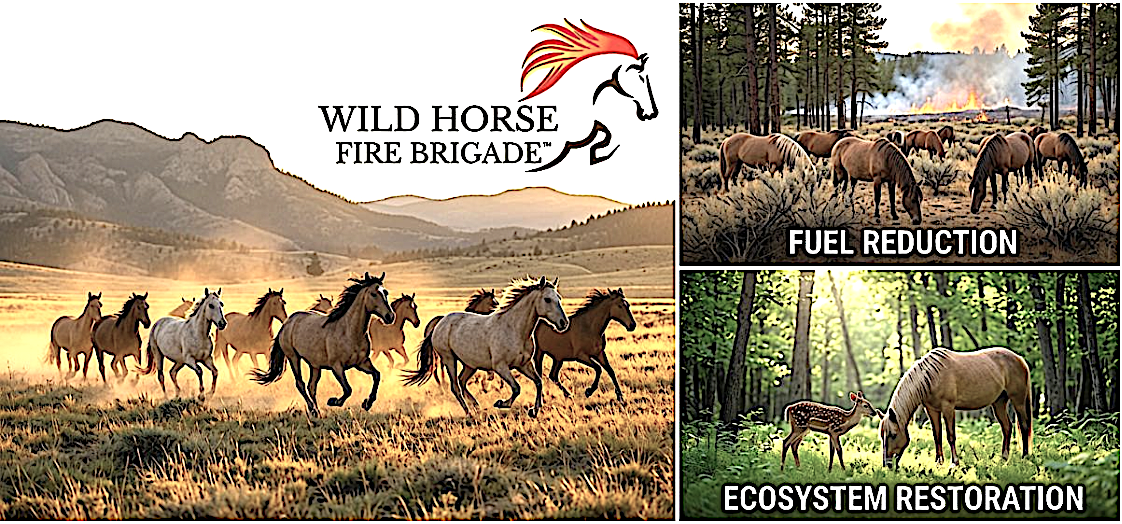
At the same time, free-roaming wild horses — once widespread across the region — have been reduced to a small remnant. The only significant cultural-heritage herd remaining in the immediate area numbers approximately 200 animals and is now under the care of Wild Horse Fire Brigade. This is a localized population, not a landscape-scale force capable of shaping fuels across the vast majority of Siskiyou’s rugged federal lands.
This is what collapsed native herbivory looks like: the primary large native grazers and browsers have been reduced to a fraction of their historic numbers across most of the landscape.
Ecologist William J. Ripple and colleagues have documented the global consequences of this pattern. In their 2015 paper in Science Advances, they showed that the loss of large herbivores alters fire regimes by increasing the quantity and continuity of fine fuels. When big native grazers disappear, ecosystems become more prone to larger, more intense fires.
Collapse of the world’s largest herbivores – Ripple et al., Science Advances 2015
Livestock grazing has been offered as a substitute. The 2026 Ranger Road Fire in the Oklahoma Panhandle and southern Kansas delivered a clear real-world test. On lands actively managed and grazed by cattle, a fire still burned approximately 283,000 acres, killed hundreds of cattle, destroyed fences and structures, and injured firefighters. As the analysis published by Pitchstone Waters concluded, intensive livestock grazing alone failed to prevent a megafire — even on designated rangeland.
Pitchstone Waters: The 2026 Ranger Road Fire Proves Livestock Grazing Alone Has Failed
If cattle cannot reliably reduce fuels on relatively accessible, managed lands, they are even less able to do so in the remote, steep, predator-filled wilderness where the majority of Siskiyou County’s large fires originate and grow. Cattle avoid those places. Wild horses and deer do not.
The solution is not more of what has already failed. It is the restoration of the native herbivores that evolved with this landscape — particularly the free-roaming cultural-heritage wild horses that still remain in parts of Siskiyou County. These animals graze year-round, create natural firebreaks, and reduce the continuous fine fuels that turn sparks into megafires. Their presence is not a novelty or a political talking point. It is an ecological function that the land once had and that modern fire management has largely discarded.
Until that function is restored at meaningful scale, Siskiyou County — and much of the rest of the West — will continue to watch small fires become the catastrophic ones that define our era.
============================
Capt. William E. Simpson II - USMM Ret.
Founder - Exec. Director - Wild Horse Fire Brigade
Ethologist - Author - Conservationist
Wild Horse Ranch
P.O. Bx. 202 - Yreka, CA 96097
Phone: 858. 212-5762
Wild Horse Fire Brigade (www.wildhorsefirebrigade.org/)
William E. Simpson II is an ethologist living among and studying free-roaming native species American wild horses. William is the award-winning producer of the micro-documentary film 'Wild Horses'. He is the author of a new Study about the behavioral ecology of wild horses, two published books and more than 500 published articles on subjects related to wild horses, wildlife, wildfire, and public land (forest) management. He has appeared on NBC NEWS, ABC NEWS, CBS NEWS, theDoveTV and has been a guest on numerous talk radio shows including the Lars Larson Show, the Bill Meyer Show, NPR Jefferson Public Radio and NPR National Radio, Global News, The Guardian, and AM BEST TV.
Check out William's Film Freeway account for films, studies, TV & radio interviews, and more HERE: https://filmfreeway.com/WilliamESimpsonII
