The Land is One System
Land management fails when soil, water, plants, wildlife, livestock, and people are treated as separate problems. Pitchstone offers a more practical approach.

Land does not organize itself into departments.
Water does not stop at the edge of a wildlife program. Cattle do not affect only grass. A decision about brush changes soil cover, water movement, insects, birds, forage, fire behavior, and the economics of keeping land intact.
Yet much of modern land management still treats these things as separate problems. One agency manages wildlife. Another funds brush control. Researchers isolate a species or treatment. Landowners are handed prescriptions for weeds, predators, grazing, fire, and water as if each could be managed alone.
Pitchstone begins from a different premise: the land is one system.
Manage relationships, not isolated parts
Healthy land is not defined by maximizing one favored species or eliminating one disliked plant. It depends on relationships among soil, water, plants, animals, climate, and human management.
Grazing offers a useful example. Animals left too long in one place can damage plants and soil. Under different conditions, managed grazing can be used to influence ground cover, nutrient cycling, plant recovery, and the distribution of water across a landscape.
The useful question is not whether cattle are inherently good or bad. It is: What are the animals doing, for how long, under what conditions, and what happens afterward?
That same discipline should apply to other interventions.
Before removing brush, suppressing predators, setting fire, spreading herbicide, or excluding grazers, we should ask what function the targeted organism or process performs—and what else may change when it is gone.
Start with what the land shows us
Pitchstone respects research, but research should remain answerable to observation.
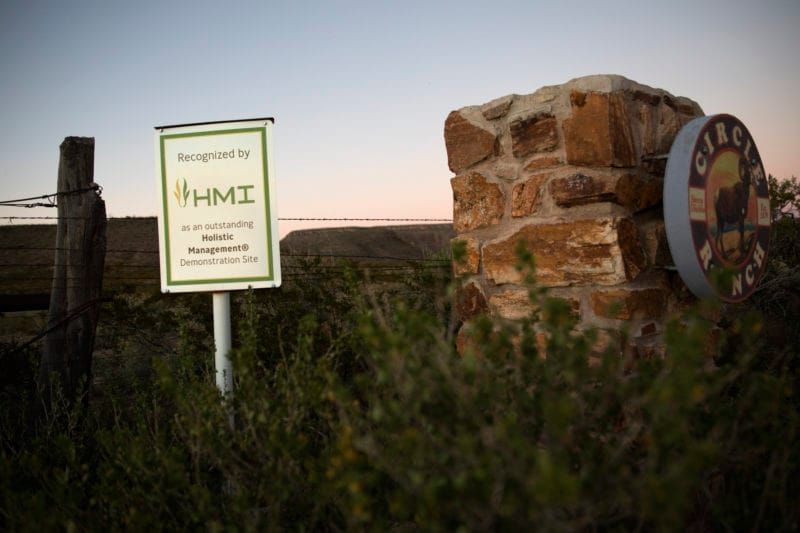
At Circle Ranch, Chris Gill and his colleagues documented efforts to restore desert grasslands using approaches including planned grazing, water harvesting, and Keyline plowing. The point was not that every practice would work everywhere. It was that visible results, costs, recovery time, and biological effects should be compared honestly with conventional treatments.
That standard matters.
A management claim does not become true because it is repeated by an agency, an industry, a university, or a conservation organization. Nor does an unconventional idea become true simply because it challenges authority.
Show the evidence. Measure the result. State what remains uncertain. Then adjust.
Skepticism should improve the work
Pitchstone has challenged official positions before, including the historical classification and treatment of elk in Texas and large-scale chemical approaches to desert grassland restoration.
Those disputes matter because classifications and management assumptions influence policy—and policy changes what happens on the ground.
- Useful questions include:
- What evidence supports the premise?
- What are the ecological effects beyond the stated target?
- What will the treatment cost?
- How long will recovery take?
- What alternatives have been tested?
- What result would cause us to change course?
Those questions should apply equally to ideas Pitchstone favors. Serious inquiry means testing our own assumptions as carefully as we test someone else's.
Offer a practical alternative
Criticism without an alternative is rarely enough.
If a chemical treatment is too broad, what more selective method can replace it? If continuous grazing degrades plants, how can animal timing and recovery be managed differently? If a wildlife classification conflicts with historical or archaeological evidence, what evidence would justify changing the policy?
A credible alternative should identify the practice, expected result, likely costs and evidence that would confirm—or challenge—the underlying idea.
It should also respect the people who must carry it out.
Ranchers, field staff, scientists, and local communities hold different kinds of knowledge. Good management creates ways to test those forms of knowledge against what actually happens on the land.
Keep ideology out of the driver’s seat
Land responds to what we do, not to the political label attached to it.
Debates about climate, livestock, native species, fire, chemicals, and conservation can become tests of allegiance. Pitchstone's interest is more practical.
Does a proposal improve soil cover, water retention, biodiversity, resilience, and the ability of people to care for the land?
What evidence supports that conclusion?
What tradeoffs are being ignored?
Useful ideas can come from people with whom we disagree. Weak ideas can exist inside movements we generally support. The objective is not to defend a camp. It is to understand what works, where, under what conditions, and at what cost.
A working philosophy
Pitchstone's approach is not a formula. It is a working philosophy:
See the whole system.
Begin with conditions on the ground.
Test claims against evidence.
Challenge policy without inventing motives.
Compare costs and consequences.
Offer a workable alternative.
Change course when the evidence requires it.
That approach is less tidy than managing one variable at a time. It is also closer to how living landscapes actually work.
The land is one system. Our management should be as well.
Pitchstone Field Notes
Explore the evidence
These ideas come from years of observation, experimentation and debate about what actually happens on the land. Here are four places to go deeper.
Restoring Desert Grasslands
See Pitchstone compare cattle, water harvesting and Keyline with conventional chemical treatment on desert grasslands.
Explore the work →Are Elk Native to Texas?
Historical and archaeological evidence showing why classifications matter when they shape wildlife-management policy.
Follow the evidence →Rancher Takes an Unconventional Path to Restoring His Land
A field-level look at Circle Ranch and the land-management experience behind many of the ideas discussed here.
See it in practice →State of Texas Resolution H.R. No. 2159
An example of evidence and wildlife classification moving from scientific debate into the public-policy process.
Read the resolution →Editorial note: This article was developed by Pitchstone Waters as institutional editorial content with AI assistance. It draws on Chris Gill’s published work and documented experience, but it is not presented as a new article written by Chris.
