American Wild Horses: Fifty-Five Years Of Removals, Gelding, And Pesticide Contraception Have Cut Genetic Flow In BLM Wild-Horse Herds
After 55 years of federal wild-horse management, what has happened to the genetic diversity of America's free-roaming herds? William E. Simpson II examines the evidence.


Wild horses have long been part of the American West, and questions surrounding their management deserve careful consideration.
William Simpson has spent years studying free-roaming horses and challenging conventional approaches to their management. In this article, he raises an important question: What happens to the genetic diversity of wild-horse populations when animals are repeatedly removed, breeding stallions are gelded, and reproduction is controlled?
Whether or not one agrees with every conclusion, the long-term consequences of these management decisions deserve scrutiny.
We are sharing William's latest work because we believe these questions warrant serious discussion.
Editor's Note: This article was written by William E. Simpson II, founder and executive director of Wild Horse Fire Brigade, and is republished with the author's permission. Originally prepared October 5, 2026, the article examines 55 years of federal wild-horse management and its potential consequences for the genetic diversity of America's free-roaming horse populations.
The research, analysis, and conclusions presented are those of the author.
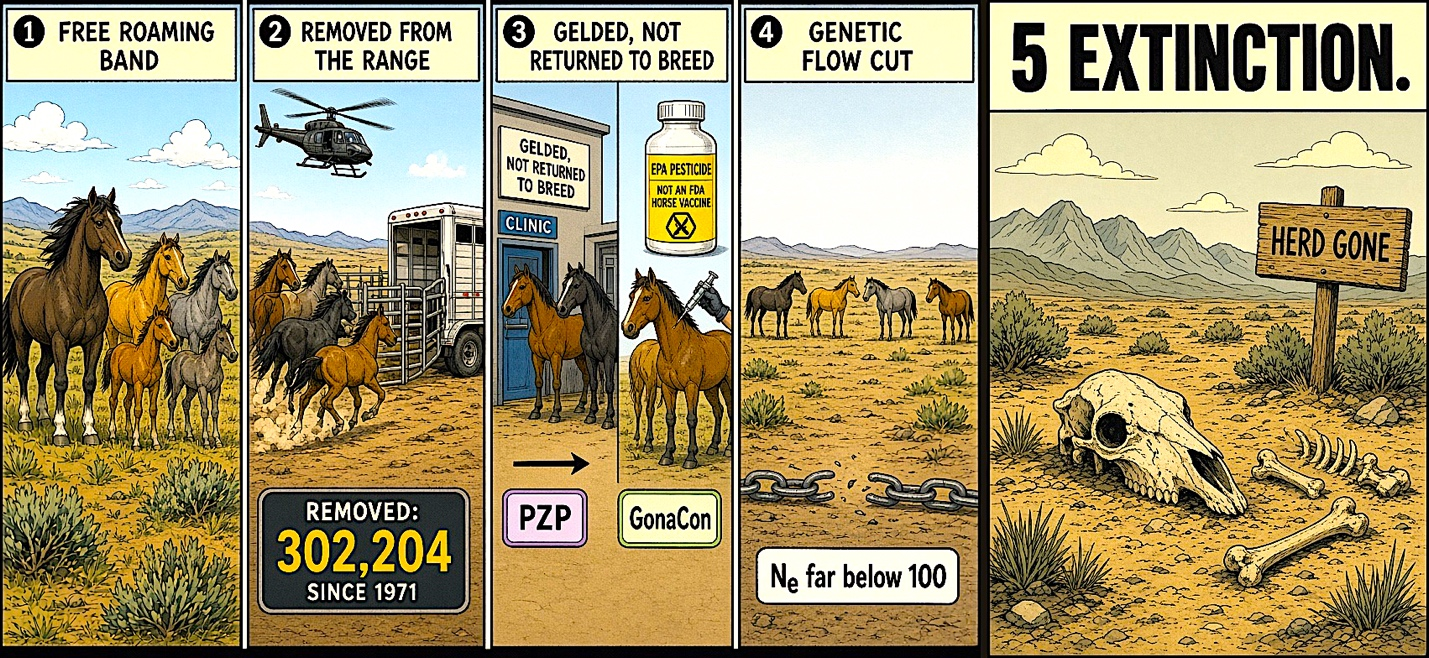
Fifty-five years of Bureau management have removed the breeding animals and held the remnants below the size required to keep genetic fitness. It did that before it sequenced the herds.
From fiscal 1971 through fiscal 2021, the Bureau’s own Public Land Statistics count 302,204 horses and burros taken off the range. Removed stallions are gelded under Instruction Memorandum 2015-153 and IM 2023-028 and do not return as sires. That loss is permanent. Placement into private care is not a return to the herd.
Sterilizing horses is not a fix for a grazing conflict. A pesticide or a gelding decides who copies alleles forward. On a herd held at 30 to 50, that is the genetic cut. The forage question remains. The rare alleles, including a dun or TBX3 haplotype that was never sequenced, go with the animals.
A sanctuary does not save the wild herd. It saves the animal after the cut. Gelded stallions copy nothing forward. Mares taken off the range do not return their alleles to the band. Housing them archives non-breeding bodies while the herd that stayed is held below the size the National Academies, in 2013, and Frankham, Bradshaw, and Brook, in 2014, say cannot keep fitness. A pen of a few dozen mares and no intact stallion is a captive remnant, not a wild population.
The products used on mares are not FDA-approved horse vaccines. ZonaStat-H is EPA Registration No. 86833-1. GonaCon-Equine is EPA Registration No. 56228-41. Both are registered pesticides. From fiscal 2012 through fiscal 2025 the Bureau removed 121,998 animals and recorded 11,209 of those treatments. About ten removals for each treatment.
Dun is the part already published. Imsland and colleagues, Nature Genetics, 2016, mapped the wild-type coat and the primitive markings to TBX3. Non-dun2 is a 1,617-base-pair deletion from domestication. Most closed breeds carry it. Dun and non-dun1 are older and are in ancient horse DNA. A band that still throws a dorsal stripe, leg bars, and a mask is carrying the ancestral switch. That is the flag, not the cargo. Wound closure, disease resistance, bone and muscle, and band intelligence have not been sequenced as a difference between these herds and a barn horse. The reckless act is the order: remove, geld, and inject before the reading.
The genetic requirement is an intact breeding population on the range, large enough to keep rare alleles, not a contraceptive schedule and not an off-range archive. That is the distinction Wild Horse Fire Brigade is built on. The cultural-heritage herd at Wild Horse Ranch is privately owned, still in family bands, still breeding, and not on a Bureau removal or darting schedule. Natural selection still takes the old, the sick, and the lame. It does not geld the sire and call the bloodline saved. Bureau off-range holding is the dominant cost of the other plan: 64,205 animals in holding as of August 2025, and about two-thirds of fiscal 2024 program spending on off-range care. An intact band that stays on the range does not generate that bill.
The Bureau has never published the stallion share of the 302,204, the names of the 47 areas that received 1,808 PZP-22 treatments, or the names of the 87 areas in the 5,400 treatments reported in 2013. The genetic cut is in the published numbers. The missing ledger does not erase it.
The Bureau of Land Management does not publish a single ledger of every herd, every stallion removed, and every mare injected since the Wild Free-Roaming Horses and Burros Act. The numbers that do exist are enough to describe the genetic result.
From fiscal 1971 through fiscal 2021, the Bureau’s own Public Land Statistics count 302,204 horses and burros removed. From fiscal 2012 through fiscal 2025, it removed 121,998 more and applied 11,209 fertility-control treatments. Removed males are gelded as policy and do not return as breeding animals.
The products used on mares are not FDA-approved veterinary vaccines. They are EPA-registered pesticides.
The National Academies told the Bureau in 2013 that an effective population size of 50 does not protect fitness. Frankham, Bradshaw, and Brook, in the 2014 revision tied to IUCN Red List criteria, put the short-term floor at an effective size of at least 100 and the long-term floor at an effective size of at least 1,000. Most appropriate-management levels sit under the census number those floors require.
The products are pesticides, not FDA horse vaccines
ZonaStat-H, the native porcine zona pellucida product, is EPA Registration No. 86833-1, first registered January 30, 2012, to the Humane Society of the United States. The active ingredients are listed as glycoprotein ZP3 and PZP at 0.1 percent. The signal word is Caution. The product type is contraceptive. It has been a restricted-use pesticide. It is not an FDA-approved veterinary biologic or animal drug for horses.
GonaCon-Equine is EPA Registration No. 56228-41, first registered January 3, 2013, to USDA APHIS. The active ingredient is gonadotropin-releasing hormone at 0.03 percent. The signal word is Caution. The product type is contraceptive. It is not an FDA-approved veterinary vaccine for horses.
PZP-22 is a pelleted PZP formulation the Bureau hand-injects after capture. It is not a separate FDA-approved horse vaccine. The Bureau cites the EPA ZonaStat-H label for liquid PZP.
Intrauterine devices used in small trials are devices, not vaccines: 8 treatments in fiscal 2021, 31 in fiscal 2022, 10 in fiscal 2024, and none in fiscal 2025.
Gelding is surgery.
Calling any of these an FDA-approved horse vaccine is false.
What genetic flow means, and the standards the Bureau was given
Genetic flow here means the passage of breeding animals and their offspring into the next generation: who remains on the range, who is allowed to breed, and whether isolated herds exchange animals.
- Removal cuts the breeding population directly.
- A pesticide that blocks foaling cuts a mare’s contribution for the life of the effect.
- Gelding a stallion and shipping him to holding removes him permanently.
- Gelding him and turning him back, as at Conger, leaves a non-breeding male on the range in the place of a sire.
- A skewed sex ratio changes who gets to breed.
The National Academies of Sciences, in Using Science to Improve the BLM Wild Horse and Burro Program: A Way Forward (2013), defined genetic effective population size, Ne, as the size of an idealized population that would experience the same random genetic drift as the herd in question.
The committee wrote that an effective size of at least 50 had been thought necessary to avoid short-term inbreeding depression, and that empirical work shows effective sizes much larger than 50 are necessary if maintenance of fitness matters. It reported that the lowest allelic diversity and heterozygosity in Bureau herds matched small, isolated, endangered horse populations, including the Sorraia.
The Bureau’s own handbook goal, which the Academies quoted, was only to keep observed heterozygosity no lower than one standard deviation below the mean of Bureau herds: a 2012 mean of 0.716, standard deviation 0.056, and a critical-risk line of 0.66. That is a floor against the Bureau’s own average. It is not a viability standard.
Frankham, Bradshaw, and Brook, Biological Conservation 170:56–63 (2014), revised the old 50/500 rules:
- An effective size of 50 does not prevent inbreeding depression.
- An effective size of at least 100 is required to limit loss of total fitness to 10 percent over five generations.
- An effective size of 500 is too low to retain evolutionary potential. At least 1,000 is the better approximation.
They wrote that the genetically derived IUCN Red List population-size thresholds for Criterion C need to be doubled. Typical Ne/N ratios in the meta-analyses they cite run about 0.1 to 0.2.
A census of 50, the upper appropriate-management level on herds such as Pokegama, implies an effective size on the order of 5 to 15 if the herd is closed, and lower still under harem breeding. A census of 150 to 200, the figure often loosely cited from Bureau handbook practice, still fails the 2014 short-term Ne of 100 once the ratio is applied, and it fails the long-term Ne of 1,000 by an order of magnitude.
The carriers were reduced before the genome was read
Dun is the part that is already published, and it is not a color story. Imsland, Andersson, and colleagues mapped the dilution and the primitive markings to TBX3 in Nature Genetics in 2016.
Pigment is laid on one side of the growing hair because TBX3 is expressed in only part of the follicle. That is the dorsal stripe, the leg bars, and the mask.
Dun is the wild-type. Non-dun2 is a 1,617-base-pair deletion that impairs TBX3 and erases the pattern. It is a domestication allele. Most closed domestic breeds are non-dun2. Dun and non-dun1 are older. Both are in ancient horse DNA. The polymorphism predates the barn.
A free-roaming band that still throws a clean stripe into the tail, leg bars, and a mask is carrying the ancestral switch. That is the visible flag. It is not the cargo.
The cargo has not been sequenced. Wound closure, disease resistance, skeletal and muscular capacity, and the intelligence of a horse that still lives in a family band are field observations and domestication contrasts. They are not a completed comparison of a herd management area against a barn breed.
Horses as a species carry a prion-protein residue, S167, that stabilizes the protein in experimental systems. That is species-level biology. It is not a sequenced difference between a Bureau herd and a Quarter Horse. Nobody has made that measurement.
The recklessness is the order of operations. The Bureau removed 302,204 horses and burros through fiscal 2021, gelded the stallions, and injected mares with EPA-registered pesticides, before it sequenced the herds it was reducing.
Rare alleles drop first under drift: a dun or TBX3 haplotype, a Spanish-remnant marker, a local lineage. A closed herd held at 30 to 50 cannot keep them.
You cannot read a bloodline after the carrier is gone.
Removals, 1971 through fiscal 2021
Public Land Statistics 2021, Table 5-13b, is the Bureau’s cumulative removal table. Forest Service removals are folded into the administrative-state totals. Mules are counted as burros. The table does not split stallions from mares.
Fiscal 1971 through fiscal 2020, then fiscal 2021:
- Nevada: 156,790 through fiscal 2020, plus 4,964 in fiscal 2021. Total 161,754.
- Wyoming: 41,141, plus 1,789. Total 42,930.
- California: 28,823, plus 690. Total 29,513.
- Oregon: 19,797, plus 2,482. Total 22,279.
- Utah: 17,942, plus 1,031. Total 18,973.
- Arizona: 14,341, plus 1,374. Total 15,715.
- Colorado: 4,603, plus 1,121. Total 5,724.
- Idaho: 3,881, plus 215. Total 4,096.
- New Mexico: 720, plus 0. Total 720.
- Montana: 500, plus 0. Total 500.
- National total through fiscal 2021: 302,204.
Nevada alone is more than half.
Montana’s 500 over half a century is the Pryor Mountain pattern: a small herd, repeated small removals, and, after 2001, pesticide darting instead of large gathers.
The Bureau states that since 1971 it has placed more than 290,000 animals into private care. Placement is not return to the breeding herd. An adopted stallion is gelded before title transfers, with narrow exceptions.
Annual removals against vaccine counts, fiscal 2012–2025
The Bureau’s program-data tables supply both series only from fiscal 2012.
- 2012: 8,255 removed, 1,045 treated (162 PZP, 883 PZP-22).
- 2013: 4,176 removed, 509 treated.
- 2014: 1,857 removed, 384 treated.
- 2015: 3,819 removed, 469 treated.
- 2016: 3,320 removed, 467 treated. First year GonaCon appears in the national table, with 15.
- 2017: 4,209 removed, 777 treated.
- 2018: 11,472 removed, 702 treated.
- 2019: 7,979 removed, 660 treated.
- 2020: 10,824 removed, 735 treated.
- 2021: 13,666 removed, 1,160 treated, including 8 IUDs.
- 2022: 20,193 removed, 1,622 treated, including 31 IUDs. Peak treatment year.
- 2023: 5,335 removed, 720 treated.
- 2024: 16,140 removed, 1,038 treated, including 10 IUDs.
- 2025: 7,853 removed, 921 treated.
Summed: 121,998 removed and 11,209 treated. About ten removals for each treatment. Treatments are mares. Removals are both sexes.
On March 1, 2025, the Bureau estimated 73,130 horses and burros on the range against a high appropriate-management level of 25,556. Its later 2026 estimate was 85,466 against 25,592. Off-range holding was reported at 64,205 animals as of August 2025.
No range contraception for the first twenty-seven years
From 1971 through 1998 the Bureau ran no range fertility-control program on its herds. Immunocontraception research in that period was captive, or it was National Park Service. Assateague Island is not a Bureau herd. Devil’s Garden and Sheldon are not Bureau herd management areas.
The first Bureau field trial named in its own instruction memorandum is Clan Alpine, Nevada, in 1999, a 22-month PZP formulation.
USGS Open-File Report 2004-1264 records the first range treatments after that:
- Pryor Mountain, September 2001: five mares, with 13 having received both injections by the end of 2002.
- Little Book Cliffs, July 2002: 23 mares, with 11 boosted by the end of 2002.
- McCullough Peaks was added to the same study in 2003. The Cody Field Office’s annual darting program there began in 2011.
Instruction Memorandum 2009-090 states that the 22-month PZP vaccine had been given to 1,808 mares in 47 herd management areas since fiscal 2004. The memorandum does not name the 47.
A Bureau figure reported by American Wild Horse Campaign on July 30, 2013, said 5,400 mares in 87 herd management areas over the prior decade. The named examples were Sand Wash, Spring Creek, Pryor, McCullough Peaks, and Cedar Mountain. The other names were not published.
Those two aggregates overlap. They are not a herd list.
The same 2009 memorandum made it policy to apply fertility control as a component of gathers unless there was a compelling reason not to. The fiscal 2018 final gather schedule shows many gathers with zero animals treated. A policy sentence is not a treatment.
Herds with a named drug or a named gelding
Standing darting programs on the fiscal 2024 through May 15, 2026 schedules:
- Pryor Mountain, PZP, 80 planned.
- Little Book Cliffs, PZP and GonaCon, 20.
- McCullough Peaks, PZP since 2011, 45, plus a GonaCon/PZP catch-treat-release in fiscal 2024.
- Stewart Creek, PZP, 50.
- Sand Wash Basin, PZP, 150.
- Spring Creek Basin, PZP, 18.
- Piceance-East Douglas, GonaCon, 100.
- Challis, PZP and GonaCon, 15.
- Hog Creek, GonaCon, 15.
- Cold Springs, GonaCon, 30.
- Sand Springs, GonaCon, 60.
- Coyote Lake/Alvord-Tule Springs, GonaCon, 60.
- Pine Nut Mountains, PZP, 50.
- Onaqui Mountain, PZP and GonaCon, 70.
- Cedar Mountain, PZP, 50.
- Range Creek, GonaCon, 15.
Planned darting total on that schedule: 828. The Bureau’s own program page says darting is not practical for most herds.
Gather or catch-treat-release, drug named in a schedule or release:
- Clan Alpine, GonaCon, 81 planned in November 2023, after the 1999 trial.
- Calico complex: Black Rock Range, Calico Mountains, Granite Range, and Warm Springs Canyon. GonaCon, 172 planned in October 2023, with five IUD retreatments noted.
- Triple B and Maverick-Medicine: 28 GonaCon treatments in fiscal 2018, and up to 50 mares released in fall 2024.
- Buffalo Hills, GonaCon, 57 planned.
- Fish Creek, PZP, 26 planned.
- Roberts Mountain and Whistler Mountain, GonaCon/PZP, 19 planned in the complex gather.
- Nevada Wild Horse Range, GonaCon, 106 planned.
- Silver King: 25 mares on GonaCon released March 12, 2021.
- Reveille: 22 mares on PZP-22 released February 12, 2020, and later GonaCon.
- Twin Peaks horses, GonaCon, 30 planned. The burro portion of that gather was removal only.
- South Steens, GonaCon/PZP, 19 planned.
- Stinkingwater: treated mares released in fiscal 2022. Agent not on the schedule line.
- Bordo Atravesado, GonaCon, 10 planned.
- Sulphur and Swasey: GonaCon primer in September 2020 and a booster before release.
- Eagle: primer in January 2021.
Those three are the herds in the Bureau’s cited booster study.
- Antelope, Water Canyon: GonaCon pilot in fiscal 2018, 12 actually treated.
- Cedar Mountain: about 200 mares on PZP-22 in February 2017, separate from later darting.
- Black Mountain, Arizona: a ZonaStat-H pilot on female burros authorized in 2017, proposed for 165 jennies.
- Saylor Creek was named for catch-treat-release in the fiscal 2025 plan.
The March 1, 2025 Herd Area and Herd Management Area Statistics parse to 139 herd-management-area rows and 105 herd-area rows with a last-gather month. The Bureau’s summary of that file says 177 herd management areas. The difference is extraction loss from the published tables, not evidence that the missing rows were never gathered.
Last gather is a date. It is not a headcount. Animal-removed totals by herd for the whole period were not published.
Stallions
Instruction Memorandum 2015-153, carried forward in IM 2023-028, tells offices to geld every male permanently removed, and every male born in holding, once he is a weanling. Exceptions are for an adopter who wants an intact horse. Horses sent to long-term pasture are gelded before they arrive. Cryptorchid males that cannot be fully castrated are euthanized under the same policy.
That rule has applied, in narrower form, since 2006 for animals four and older, and since 2009 for weanlings. Every removal since those dates has taken breeding stallions out of the herd and, as policy, sterilized them before adoption or pasture. The Bureau has never published the stallion share of the 302,204.
Release of geldings back onto a herd management area is a different act. The Bureau’s March 18, 2022 account says it has usually not done this except in a few herds, and it documents one.
At Conger, Utah, about 40 percent of males were gelded after the 2017 gather and released. Frisco was the intact control. Sarah King and U.S. Geological Survey coauthors found a moderate drop in mare fertility in the first year only. Geldings that held harems tended to lose them.
Garrott and Siniff, in 1992, estimated that about 80 percent or more of a herd’s stallions would have to be gelded before growth fell substantially. Conger did not reach that fraction. The Bureau did not name the other herds.
There is no operational program of GonaCon in males or of chemical vasectomy.
Sex-ratio skew is not gelding. At Fifteenmile, Wyoming, in September 2026, the Bureau released 61 stallions, 45 mares, and 3 foals, described as intact, at about 60 percent male.
Jackson Mountains, Nevada, is an authorization, not a completed sterilization. The August 6, 2026 herd management area plan opens sterilization of mares and stallions up to one-third of the low appropriate management level of 130. Counsel told Wild Horse Education that the September 2026 removal would not include sterilization or fertility-control treatment. The authority remains in the plan.
What the numbers do to a closed herd
A herd held at 30 to 50, the Pokegama appropriate management level, cannot meet either genetic standard above if it is managed as a closed population. The fiscal 2026 schedule lists Pokegama as an emergency bait-trap removal of 30, with zero fertility-control treatments. Removal without a drug is still a genetic-flow cut.
The Bureau’s proposed fix on other small herds, stated in its own AML papers, is to import a mare every decade and to contracept or geld the animals returned. That is a breeding program imposed on a remnant. It is the opposite of a self-sustaining free-roaming population.
The Academies were asked what population-control decisions do to genetic diversity, social behavior, and herd health. The record since 2013 is that removals remained the dominant tool by an order of magnitude, that pesticide use expanded from a few dartable herds to a still-small set of herds and to mares released after gathers, and that gelding of removed stallions continued as uncounted policy.
The Bureau’s March 1, 2025 estimate of 73,130 on the range, against a high appropriate-management level of 25,556, is not evidence that the breeding populations inside those appropriate-management levels are genetically viable. The appropriate-management level is the number the Bureau manages toward. On the herds managed at a few dozen animals, that number fails the 2013 Academies warning and the 2014 revision of the IUCN-linked thresholds.
Sterilization is not a range fix, and a sanctuary is not a saved herd
Sterilizing horses does not settle a grazing conflict. It ends the breeding population that was supposed to be managed.
A pesticide that blocks foaling, or a surgery that gelds the stallion, decides who copies alleles forward. On a herd already held at 30 to 50, that is the genetic cut. The forage question remains.
A sanctuary does not repair it. A sanctuary saves the individual after the cut. Removed stallions are gelded and do not return as sires. Mares placed in private care do not return their alleles to the band. Placement of more than 290,000 animals since 1971 is not a return to the herd.
A pen of a few dozen mares and no intact stallion is a captive remnant. It is not a wild population.
The genetic requirement is an intact breeding population on the range, large enough to keep rare alleles, not a contraceptive schedule and not an off-range archive.
That is the distinction Wild Horse Fire Brigade is built on. The cultural-heritage herd at Wild Horse Ranch is privately owned, still in family bands, still breeding, and not on a Bureau removal or darting schedule. Natural selection still takes the old, the sick, and the lame. It does not geld the sire and call the bloodline saved.
Bureau off-range holding is the dominant cost of the other plan: 64,205 animals in holding as of August 2025, and about two-thirds of fiscal 2024 program spending on off-range care. An intact band that stays on the range does not generate that bill.
What is still withheld
Three facts are not in any public table:
- The names of the 47 herd management areas that received the 1,808 PZP-22 treatments from fiscal 2004 to 2009.
- The names of the 87 that made up the 5,400 treatments reported in 2013.
- The number of stallions inside the 302,204 removals, and the names of the herds other than Conger where geldings were released.
Instruction Memorandum 2009-090 required field offices to file a Gather, Removal, and Treatment Summary Report with the national office. Those reports are the missing ledger. They are not on the public site.
References
- Wild Free-Roaming Horses and Burros Act of 1971, 16 U.S.C. §§ 1331–1340.
- U.S. Bureau of Land Management, Public Land Statistics 2021, Table 5-13b, Wild Free-Roaming Horse and Burro Removals by State, Fiscal Year 2021, including the fiscal 1971–2020 cumulative columns. blm.gov
- U.S. Bureau of Land Management, Program Data, fertility-control treatments by agent, fiscal 2012–2025, and removals by fiscal year. blm.gov
- U.S. Bureau of Land Management, Herd Area and Herd Management Area Statistics as of March 1, 2025.
- National Academies of Sciences, Engineering, and Medicine, Using Science to Improve the BLM Wild Horse and Burro Program: A Way Forward (National Academies Press, 2013), chapter 5, Genetic Diversity in Free-Ranging Horse and Burro Populations. nap.nationalacademies.org
- Frankham, R., Bradshaw, C.J.A., and Brook, B.W., Genetics in conservation management: Revised recommendations for the 50/500 rules, Red List criteria and population viability analyses, Biological Conservation 170:56–63 (2014).
- U.S. Environmental Protection Agency, ZonaStat-H, Registration No. 86833-1, first registered January 30, 2012, registrant Humane Society of the United States. Pesticide product; not an FDA veterinary vaccine.
- U.S. Environmental Protection Agency, GonaCon-Equine, Registration No. 56228-41, first registered January 3, 2013, registrant USDA APHIS. Pesticide product; not an FDA veterinary vaccine.
- Ransom, J.I., and Roelle, J.E., Open-File Report 2004-1264, U.S. Geological Survey, documenting Pryor Mountain treatments beginning September 2001 and Little Book Cliffs treatments beginning July 2002.
- U.S. Bureau of Land Management, Instruction Memorandum 2009-090, Population-Level Fertility Control Field Trials. States that 1,808 mares in 47 herd management areas received 22-month PZP since fiscal 2004, and identifies the 1999 Clan Alpine trial.
- U.S. Bureau of Land Management, Instruction Memorandum 2015-153, Gelding of Wild Horses and Burros; Instruction Memorandum 2023-028, Animal Health, Vaccinations, Gelding, and Microchipping.
- U.S. Bureau of Land Management, “Managing wild geldings on public lands,” March 18, 2022, Conger Herd Management Area, about 40 percent of males gelded after the 2017 gather. blm.gov
- Garrott, R.A., and Siniff, D.B., Limitations of male-oriented contraception for controlling feral horse populations, Journal of Wildlife Management 56:456–464 (1992), as cited by the Bureau: about 80 percent or more of stallions gelded to substantially reduce growth.
- U.S. Bureau of Land Management, tentative gather and fertility-control schedules, fiscal 2018, 2022, 2024, 2025, and May 15, 2026.
- U.S. Bureau of Land Management press releases: Cedar Mountain PZP-22 treatment, February 8, 2017; Silver King GonaCon release, March 8, 2021; Reveille PZP-22 release, February 13, 2020.
- American Wild Horse Campaign, July 30, 2013, reporting the Bureau’s figure of 5,400 mares treated in 87 herd management areas over the prior decade.
- Congressional Research Service, Wild Horse and Burro Management: Overview of Costs, IF11060, off-range holding of 64,205 as of August 2025, and 175 herd management areas.
- Wild Horse Education, September 24, 2026, on the Jackson Mountains herd management area plan of August 6, 2026, and the representation that the September 2026 removal would not execute sterilization.
Prepared October 6, 2026. Figures are Bureau publications and the papers cited. Where the Bureau did not publish a herd name or a stallion count, the gap is marked. It is not filled.