America Is Repeating Brazil’s Amazon Disaster — While Systematically Destroying the Only Animal That Could Prevent It
This post argues that decades of livestock-focused land management and wildfire suppression have degraded public lands, while wild horses may offer a natural, low-cost solution for reducing fuels, restoring ecosystems, and improving resilience.


In this opinion essay, William E. Simpson II argues that federal land management policies have prioritized cattle grazing, prescribed burning, and wildfire suppression at the expense of more natural ecological solutions. Drawing on more than a decade of field observations among free-roaming wild horses, he contends that wild horses can function as effective ecosystem engineers—reducing wildfire fuels, restoring biodiversity, stabilizing soils, and supporting healthier watersheds. Simpson further argues that current wildfire management strategies are both economically inefficient and ecologically unsound, calling for a fundamental shift toward nature-based approaches that incorporate wild horses into landscape restoration and wildfire prevention efforts.
NOTE: this article was originally sent to us by email, via Captain William Simpson of Wild Horse Fire Brigade.
By William E. Simpson II
Founder & Executive Director, Wild Horse Fire Brigade
Ethologist & Naturalist — 12+ Years Immersive Study of Free-Roaming Cultural-Heritage Wild Horses
For decades, Brazil has been criticized for clearing and burning vast portions of the Amazon rainforest to create pasture for cattle. The consequences have been profound: biodiversity loss, destruction of Indigenous lands, massive carbon emissions, and the degradation of one of the planet’s most important ecosystems. Today, cattle ranching accounts for roughly 80% of Amazon deforestation.
According to William E. Simpson II, a similar dynamic is unfolding on public lands in the United States.
A Challenge to Conventional Land Management
In 2019, Simpson publicly challenged the Department of the Interior's reliance on prescribed burning as a primary fuel-reduction strategy. He argues that repeated burning and livestock-focused management can create ecological outcomes that mirror the long-term effects of forest clearing in other parts of the world.
At the heart of his argument is a stark contrast between domestic livestock and wild horses.
Simpson contends that cattle and sheep—both ruminants—are poorly suited for wilderness ecosystems. Their grazing patterns, soil impacts, and seed destruction, he argues, can contribute to ecological degradation when compared to native herbivory processes.
By contrast, he views wild horses as highly effective ecosystem engineers.
Twelve Years Among Wild Horses
For more than a decade, Simpson has lived alongside and studied a herd of approximately 200 free-roaming cultural-heritage wild horses near the California-Oregon border.
Using an immersive observational approach inspired by Jane Goodall's fieldwork, he has documented what he believes are significant ecological benefits associated with wild horse grazing.
As hindgut fermenters, horses pass viable seeds and beneficial microbiota through their digestive systems. Simpson argues this process helps reseed burned landscapes, stabilize soils, reduce erosion, and support healthier watersheds.
In his words, wild horses effectively:
- Mow vegetation
- Fertilize landscapes
- Disperse seeds
- Support biodiversity
He argues these functions create habitat conditions that benefit numerous native species, including deer, elk, rabbits, pollinators, trout, and salmon.
The Cost of Fighting Fire
Simpson also criticizes federal wildfire spending priorities.
He notes that wildfire suppression consumes a substantial portion of the U.S. Forest Service budget, while preventative measures receive comparatively less funding.
According to Simpson, this imbalance creates incentives that favor reacting to fires rather than preventing them.
Meanwhile, federal agencies continue to remove wild horses through helicopter gathers, long-term holding programs, and fertility control efforts.
Simpson argues that these policies remove animals that could otherwise contribute to natural fuel reduction.
Lessons from the Klamathon Fire
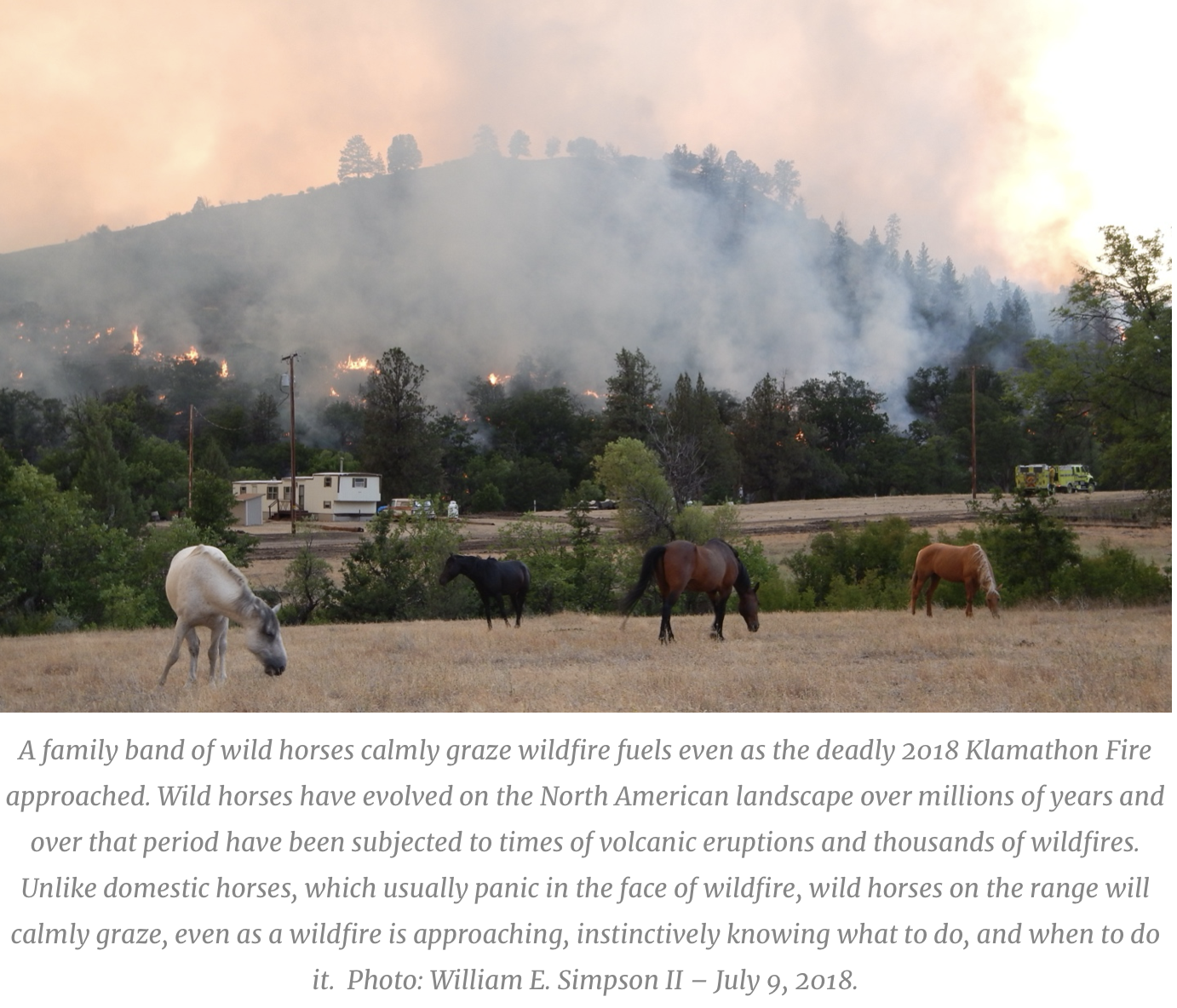
A central pillar of Simpson's argument comes from observations made during the 2018 Klamathon Fire.
While serving as a volunteer technical advisor on the fire line, he documented areas heavily grazed by wild horses that he says functioned as natural fuel breaks.
According to Simpson, those landscapes experienced reduced fire intensity and helped protect portions of the Cascade-Siskiyou National Monument and nearby communities, including Ashland, Oregon.
The experience reinforced a concept he had previously outlined in the documentary Fuel, Fire and Wild Horses.
The Human Cost of Wildfire Smoke
Simpson argues that the consequences of current land management extend well beyond burned acreage.
He points to research from UCLA estimating that wildfire smoke contributed to more than 52,000 premature deaths in California between 2008 and 2018, along with hundreds of billions of dollars in economic costs.
Additional research published in 2025 suggested that wildland fires may emit significantly more harmful pollutants than previously estimated, increasing concerns about the health impacts of wildfire smoke.
According to Simpson, these findings underscore the need for more preventative, ecosystem-based approaches to wildfire management.
A Different Vision for Public Lands
Simpson's proposed solution centers on carefully rewilding horses in appropriate wilderness landscapes where they can contribute to fuel reduction and ecological restoration.
He argues that wild horses represent a low-cost, nature-based tool for reducing wildfire risk while simultaneously supporting biodiversity and watershed health.
Whether policymakers ultimately embrace that vision remains uncertain. But Simpson believes the science, economics, and ecological realities all point toward the same conclusion:
America's public lands need a fundamental course correction.
The question, he argues, is whether land managers will be willing to challenge longstanding assumptions and explore new approaches before the next generation of catastrophic wildfires arrives.
Selected References
- Connolly et al., Science Advances (2024)
- UCLA Newsroom: "The Death Toll from Wildfire Smoke" (2024)
- Huang et al., Environmental Science & Technology (2025)
- NPR: "Meet the Man Who Says Wild Horses Could Help Prevent the Next Wildfire" (2022)
- American Forests: "How Wildfires Are Burning Through the U.S. Forest Service Budget" (2015)
- Simpson, William E. Field Documentation from the 2018 Klamathon Fire