
Ranchers Are Falling Into Debt and Selling Land. Carbon Credits Are a Way to Keep Farming
By introducing regenerative agricultural techniques that lock carbon into grazing pastures, Grassroots Carbon is offering a new income source to farmers

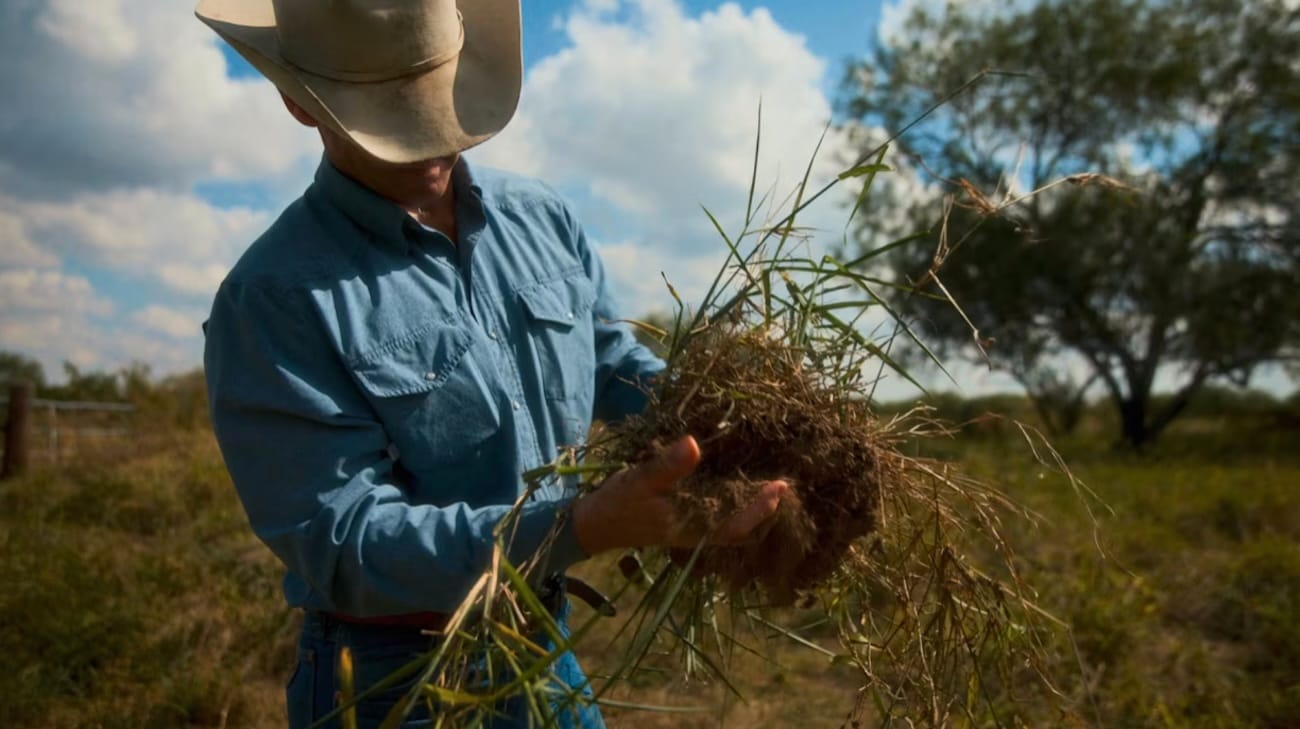
"Cattle farmers are nurturing a new stream of income they hope will keep them on their land—carbon credits."
NOTE: this article was originally published to WSJ.com on January 5, 2026. It was written by Yusuf Khan.
Frates Seeligson’s family have been farming cattle for four generations, ranching just outside of the city of Nixon in South Texas. In recent years he’s watched as some of his fellow ranchers have run into debt and sold off their land to property developers.
“If you look at the business model of agriculture it’s somewhat broken,” said Seeligson. “It’s capital and labor intensive with a very small return, and then you’re subject to the whims of nature,” he said. “Presently in South Texas, we’re in a horrible drought. I can’t control the weather. I can’t make it rain.”
For many ranchers, drought, rising costs and inflation—as well as younger generations turning their backs on the industry—have meant selling off pastures has been preferable to going into the red. That’s despite the land having sustained their families for generations. Nearly a quarter of American farms were in debt in 2022, according to the U.S. Department of Agriculture. Seeligson noted a tractor now costs more than $100,000.
But now some cattle farmers are nurturing a new stream of income they hope will keep them on their land—carbon credits.
Seeligson is one of a number of ranchers working with carbon credit developer Grassroots Carbon, which helps cattle farmers deploy regenerative agricultural techniques that sequester carbon in soil and then pays out regular checks for capturing the carbon. The more they store in the land beneath their feet, the more they can earn from selling credits tied to it.
“The carbon check allows me as a landowner to go ahead and invest [in my ranch] over time,” said Seeligson. “Knowing it will be there for the next year and the next year really can allow me the opportunity to make those investments.”
To date, Grassroots has sold more than 1.9 million tons of carbon-removal credits, it said. It estimates that a billion tons of carbon could be stored in soils across the 655 million acres that make up America’s grasslands. The Intergovernmental Panel on Climate Change estimates that 10 billion tons of carbon dioxide will need to be removed each year to limit global warming to the Paris goal of 1.5 degrees Celsius.
Early backers in the project include Microsoft, Nestlé and Chevron. Credits have sold for between $40 and $65 a ton, and have a lifetime of 100 years, according to the company. So far cattle farmers have earned up to $25 per acre for sequestering a ton of carbon for a year.
Regeneration
Regenerative agriculture is a growing movement that promotes certain farming techniques in an effort to limit the industry’s impact on the environment, while remaining productive. The United Nations estimates that agrifood systems account for roughly a third of global carbon emissions, so methods to lower the sector’s impact can have a significant impact on the planet’s health.
Regenerative ag techniques include no-till farming, where crops are planted without plowing the soil, planting cover crops in an off season, which helps to avoid soil erosion, and planting more diverse crop species, aiding in nutrient recycling. Like geothermal energy, regenerative ag is notable in that it is a sustainable practice that has proved popular with the Trump administration. Secretary of Health and Human Services Robert F. Kennedy Jr. is a prominent supporter. Last month, the USDA launched a $700 million regenerative pilot program aimed at improving soil health, water quality and productivity.
“Our business was started in 2021 with a really simple thesis: proving that regenerative ranching should be the most profitable and productive form of ranching,” said Brad Tipper, chief executive of Grassroots.
The developer encourages cattle farmers to use techniques like rotational grazing to keep livestock moving so that grasslands regenerate faster. Rotational grazing is a common practice in farming, but Grassroots suggests ranchers rotate more often, sometimes daily and on smaller properties, multiple times a day. This includes using temporary fencing to keep cows and sheep in certain areas for a period of time and putting collars on livestock that vibrate when animals approach no-go areas.
Seeligson, for example, used to have nine permanent pastures on his nearly 5,200-acre Pajarito Ranch. Now he operates 28 temporary pastures, moving cattle every two to three days, and not returning to the same part of his ranch for at least four months. He employs “hot wire” electric fencing and sirens to let his herd know that it is about to relocate, something his cows have become used to since he started work with Grassroots Carbon in 2021. When the sirens sound and the fences move, the cows know to move, he said.
Moving livestock often helps to avoid overgrazing and keeps soil from getting too compacted, according to Grassroots. Manure from the animals helps fertilize the soil. Grasses grow longer, roots grow deeper and soils become healthier, locking carbon below the ground long term.
Grassroots measures carbon in soil by taking soil samples before rotational grazing commences. Samples are taken at depths of about one meter and analyzed by a third-party company, EarthOptics. Later, another sample is taken using the same process, to see how much more carbon has been added. That difference is what generates the carbon credit, the company says.
Allen Williams, a researcher and rancher who studies regenerative agriculture, said animals get too much share of the blame when it comes to emissions. Instead, Williams said, the focus should be on farming techniques.
“It’s our management of the livestock that determines whether they are a tool for positive change or a tool for negative results,” he said.
He added the grasses grown using regen ag techniques have much deeper roots. This helps to store more carbon underground as the soil holds together more easily, meaning it doesn’t get washed away during floods while microbes in the soil have more nutrients to feed on, making the soil healthier.
Williams said ranchers have also been seeing benefits outside of carbon sequestration. He said higher quality grasses have meant herds are becoming healthier, with more heads of cattle per acre. Herd pregnancy rates have also grown. Recent scientific studies estimate a 1% increase in soil organic matter can help soils to hold up to roughly 20,000 additional gallons of water per acre, an important factor in avoiding flooding.
Emily Johannes, senior vice president of Farm Journal and former Nestlé sustainability director, said Grassroots’ work to build trust with ranchers has been key to getting companies to buy into the project.
She said companies aim to mitigate risk within their supply chains, and making sure farmers are willing to try new techniques helps avoid those risks. “The fact that Grassroots Carbon has the credibility it has in agriculture, that it has the knowledge and the connections in agriculture, that is not lost on the corporations that are trying to work with them,” Johannes said.
Seeligson signed up his entire ranch with Grassroots to sequester carbon on his ranches and invites other ranchers to see his operation, in the hope they sign up also.
“I see the carbon market as another income source to help families stay on the properties,” he said. “To be able for the next generation to say ‘this is viable, I can make a living doing this.’ The carbon is just one more income stream to help people manage their operations.”