
An Insidious Pest Threatens Texas Cattle. It’ll Have to Get Past These Guys.
The New World screwworm has been infecting livestock just over the border, in Mexico. “Tick riders,” a 120-year-old group of mounted USDA inspectors, are the nation’s first line of defense.


New World screwworm—a flesh-eating parasite moving north through Mexico—poses a serious threat to U.S. livestock, wildlife, and the broader agricultural economy. This article below highlights the role of the USDA’s “tick riders,” a long-standing force of mounted inspectors along the Texas–Mexico border, who are now being tasked with spotting and stopping infected animals before the parasite crosses into the United States.
NOTE: this article was originally published to Texas Monthly on April 6th, 2026. It was written by Lauren Larson.
A rancher found the week-old calf in a hog trap in March. Where its tail should have been was instead a wet, black mass. Maggots squirmed at the center of the necrotized flesh, and flies dotted its periphery. “This one,” says Doug Anderson, pausing the video and pointing to one fly in particular, “is the one I was worried about.”
The grisly scene on his computer’s monitor stands in horrific contrast to the framed photos of Anderson’s smiling children on the wall of his office in Rio Grande City, about forty miles northwest of McAllen. Anderson is the supervisor of field operations for the Cattle Fever Tick Eradication Program, an initiative of the U.S. Department of Agriculture’s Animal and Plant Health Inspection Service.
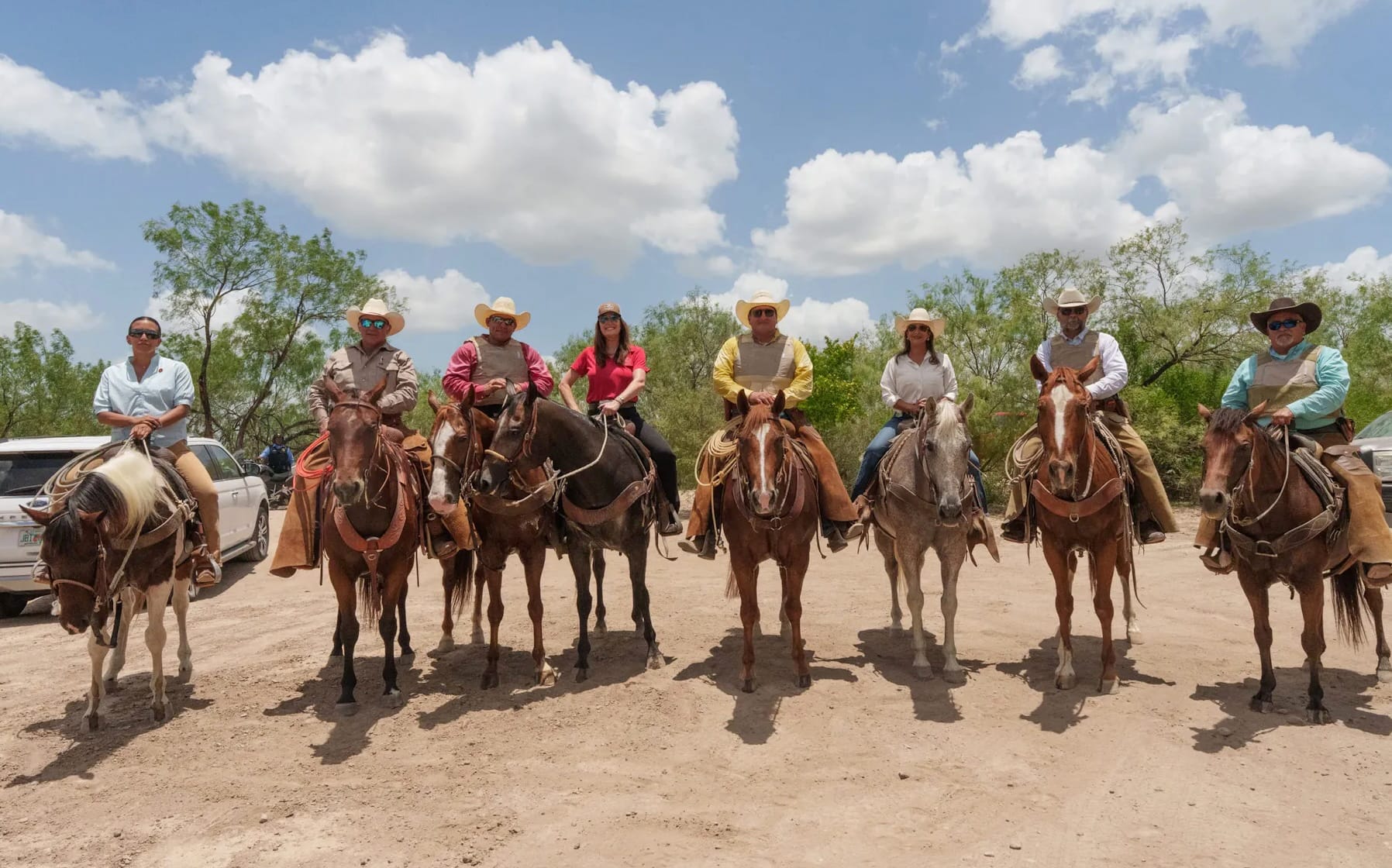
He oversees the “tick riders,” who patrol ranches along the Mexican border on horseback, inspecting cattle for pests, treating strays with pesticides, and watching out for livestock that have wandered across the border. They bring the foreign invaders in to be tested; if the cattle are free of diseases and bugs, the agency attempts to return them to their owners.
Whenever the air conditioning shuts off in Anderson’s office, stilling the blue-and-silver ribbons tied to the vent, we can hear the lowing of hundreds of animals next door, at Triple G Livestock Auction. Anderson, who is 53, wears work boots, blue jeans, a big belt buckle sporting his initials, and a thick, brown Wrangler shirt. A pen protrudes from one chest pocket, and the circular outline of a smokeless tobacco container is visible through the fabric of the other.
Since the eradication program launched in 1906, tick riders have generally looked for cattle-fever ticks, which cause a disease called babesiosis, the symptoms of which include fever, lethargy, neurological and respiratory distress, and pregnancy loss. But lately the riders have been on the lookout for an even more dangerous pest: the New World screwworm, a fly that lays its eggs in wounds and other bodily openings. Infestations can be disastrous and even fatal for cattle. (The flies can latch onto any mammal, including humans; if you feel maggots writhing within an open wound, seek care.)
The New World screwworm is what Anderson feared he had spotted on the calf in the video. Because Mexico is experiencing an outbreak of the pest, with cases reported within 150 miles of the border, the USDA is bolstering its lines of defense. The tick riders have been particularly alert for open wounds. To positively identify the insect, which is about the same size as a common housefly, inspectors look for three lines on its back. On a less harmful species of screwworm, which only feeds on dead flesh, the lines are all the same length, but the New World screwworm has a middle line that’s slightly shorter than the others. The position of the wings is also a tell: The New World holds them further back than other species.
The suspicious fly on this calf appeared to have the shorter center stripe, and its wings were daintily crossed on its back. Inspectors collected samples of the maggots from the wound, which were overnighted to Ames, Iowa, for testing at the National Veterinary Services Laboratories. The next morning, Anderson received an email: The maggots weren’t New World screwworms. Any relief was temporary. He believes the insidious pest’s arrival in the United States is a certainty, especially now that cooler temperatures, in which flies are less active, have given way to spring.
Though the New World screwworm was eradicated in the U.S. in 1966, relatively small outbreaks since then have been devastating. A 2025 analysis by APHIS, of a rash of Texas cases in 1976, estimated that a similar event could cost producers $732.6 million annually, and that the total loss to the state’s economy could reach $1.8 billion per year. “Following the near absence of screwworms in 1977, we face a real challenge in avoiding apathy,” warned the authors of a 1978 study of Texas outbreaks. “We must not let that happen!”
USDA isn’t only counting on the vigilance of the tick riders. Among other measures, the agency is releasing hundreds of millions of sterile male flies into the wild as a population-control measure. (Female screwworm flies only mate once in their ten- to thirty-day lifetimes.) Sterile screwworms are being bred at a facility in Panama and another in Mexico, and Anderson suspects the fly he spotted was one of those. Construction on another facility, to create even more sterile flies, was recently completed at Moore Air Base, in Edinburg, and USDA is supporting renovations of another facility in Mexico, which currently breeds sterile fruit flies.
The tick riders, meanwhile, provide a critical layer of surveillance. There are 64 inspectors, but Anderson has just finished interviewing candidates for fourteen more. For many, the job is a calling. Anderson’s grandfather was a tick rider, and though he demurred—for several years he ran two dry cleaners in Lubbock—he had long wanted to follow in his grandfather’s hoof-steps. In his early thirties, he leapt at the offer of a one-year contract role with the tick riders, during which he was hired full-time.
In the office next to Anderson’s sit J. C. Montes and Rene Munoz, who likewise joined the tick riders decades ago. “It’s the closest you’re going to get to living as a cowboy without being in the rough,” says 39-year-old Montes, whose uncle was also a tick rider, in nearby Zapata County. In becoming one himself, Montes found a career path that would allow him to indulge in horsemanship and roping, but which also came with health insurance and a pension.
Munoz transitioned into solely administrative duties after a horse he was riding stepped in a hole, then rolled over him. He taps different limbs, Macarena-like, to point out which bones were broken, then spits tobacco juices into a water bottle on his desk. Anderson, as if offering an amen, leans over and spits into a wastebasket at his feet.
The job involves long, solitary days in the sun, made hotter by the bulletproof vests the riders must wear. They have long carried firearms for protection, but Anderson says they’ve only worn the vests since 2009. He acknowledges, a little sheepishly, that he may be responsible for this. On patrol one day, he had ridden from his vehicle to the Rio Grande and was about to head back when he heard several pops and felt his shoulder begin to sting. Next came the sound of a motorcycle driving off, and his horse broke into a sprint. Anderson, clutching the horn of his saddle, managed to reach up to his aching shoulder and felt wetness but no entry wound. His hand came away lime green. “They shot me with a paintball gun,” he says dryly.
When the tick riders see human border crossers on their patrols, they turn and ride the other way. They are often alone in remote areas, and immigration enforcement isn’t part of the job. (Once, Anderson stumbled upon a woman who was in labor. He sat with her until Border Patrol arrived.) Unsettling encounters are rare, but each of the men has stories. Once Montes was crossing a levee on horseback when he looked up to see a group of men, their faces mostly covered, pointing guns at him. He hid his own weapon in his shirt and moved as if he didn’t see them.
“I had the scary deal twice,” Munoz says. One time he came across a group of armed men in camouflage and, like Montes, hid his weapon and rode on. On another occasion he was attempting to block a trail that Mexican cattle were using to cross the river. A machine-gun-toting man in a boat, who had no apparent connection to the livestock, began menacing him. Munoz stayed, blocking the cattle’s path for thirty minutes, until backup arrived.
Most of the riders’ encounters are with ranchers. Besides being able to handle horses and livestock, the inspectors must be able to maintain good relationships with the public. “You never know if you’re gonna get a good guy today or a bad guy today,” Montes says.
“You’re always gonna have your Karens,” Anderson acknowledges. Some ranchers associate the agency with regulatory activity and avoid the riders, but others reach out to them proactively. Like a dermatologist receives photos of moles, Anderson and his colleagues field calls and messages from ranchers about insects they find on cattle. “It used to drive my wife nuts,” he says. “We’d be sitting in church on Sunday, and my phone would be buzzing in my back pocket.”
For the longtime riders, the non-cowboy components of the job are a negligible tax for a career on horseback. Like Anderson, Montes and Munoz grew up riding. It concerns Anderson that people with the necessary skills are rarer than when he started. The agency can train new hires in how to handle firearms, how to handle pesticides, and how to identify fever ticks and screwworms, but it cannot teach them the shorthand that comes from time spent on ranches.
“We’re a dying breed,” Anderson says. “The older generations have died off, and the new generation that has inherited the ranch doesn’t even live here. They don’t employ cowboys anymore. And the young generation growing up, a lot of them would rather sit there and have this in their hand”—he raises his phone and shakes it—“rather than a rope.”
To visualize the scale and speed of the devastation possible should the New World screwworm reach the U.S., one need only walk across the dusty lot outside Anderson’s office to the Triple G Livestock Auction. In the middle of the sale ring, an auctioneer in a black cowboy hat slumps in a chair on a platform, one foot up on a rail in front of him, his posture as languid as his words are quick. Calves bound around beneath him as he rattles off the bids. On busy Fridays, says Triple G’s public relations manager, Billy Guerra, up to seven hundred cattle might pass through the sale barn. If any one of those cattle were to carry a New World screwworm, it could expose an entire herd elsewhere in the state to the parasite.
But the auction house is tightly run. In a labyrinth of pens behind the sale barn, employees inspect and “dip”—a gentle word for a dramatic process—the cattle in the insecticide coumaphos, better known by the brand name Co-Ral. After the animals leave Triple G, though, their safety is the responsibility of ranchers.
The task of containing a cattle-fever-tick outbreak can feel monumental when one considers that a female tick can lay up to four thousand eggs, which then breed in rapidly compounding numbers. What are several dozen tick riders against a force of microscopic millions? Anderson has sometimes been frustrated by the limits of his capabilities. “I felt like, I can’t be everywhere I need to be at one time,” he says.
But over twenty years, he has seen how effective inspection and quarantine can be. He’s also seen how difficult it can be, as when COVID-19 tore across the globe. Fortunately for the tick riders, cattle are easier to corral than people.