American Farmers Slid Solar Panels Over 62,000 Acres Of Farmland, And The Biggest Payoff Had Almost Nothing To Do With Electricity
Research from the University of Arizona found that crops grown beneath elevated solar arrays often yielded as much or more than those in full sun while using significantly less water.

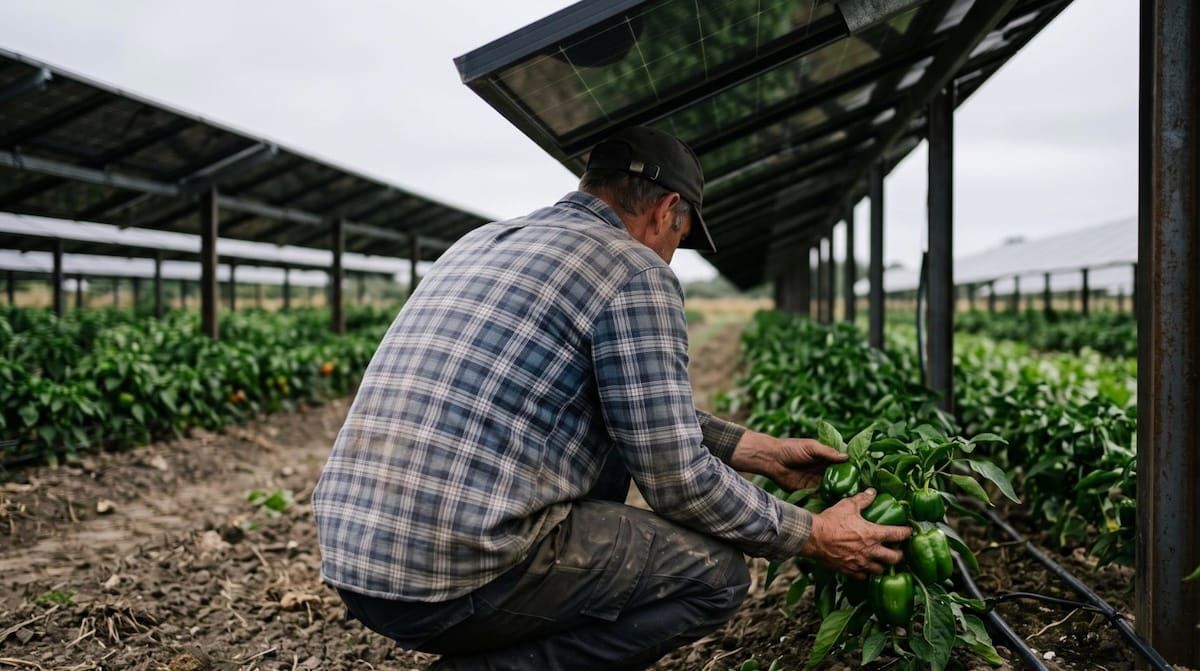
This article highlights the growing promise of agrivoltaics—placing solar panels above working farmland so the same acre can produce both food and electricity. Research from the University of Arizona found that crops grown beneath elevated solar arrays often yielded as much or more than those in full sun while using significantly less water, and the cooler microclimate created by the plants also improved solar panel efficiency. As electricity demand rises and water becomes increasingly scarce, the approach suggests that farming and renewable energy may be partners rather than competitors.
I've never had much patience for false choices. Folks have spent years arguing that a piece of land has to be either a farm or a power plant, when nature keeps reminding us that healthy landscapes are capable of doing more than one job at a time. If we can grow food, conserve water, and generate electricity from the same ground without sacrificing productivity, that's the kind of practical innovation worth paying attention to. The best conservation solutions usually work with natural systems instead of trying to replace them.
NOTE: this article was originally published to EnergiesMedia.com on August 1, 2026. It was written by Hugo Rojas.
From a low ridge in southern Arizona, the field below looks like a mistake.
Long rows of solar panels march across the desert, and underneath them, where the ground should be baked and bare, there are rows of green.
Peppers, squash, and leafy greens are growing in the striped shade, fed by the same sun the panels sit under.
The plants returned the favor, because moisture rising off the leaves cooled the panels overhead and nudged up how much power they made.
Farmers who planted them expected a thin, struggling crop in the shade.
They got something much closer to the opposite.
Word of the results has spread from one research plot to farms across the West.
The harvest that made no sense
Shade is supposed to be the enemy of a farm.
Crops chase sunlight, so roofing a field with panels ought to starve them.
Yet plot after plot came in with more fruit, not less, and the plants looked healthier than the ones baking in the open.
Stranger still, the shaded rows did it while drinking far less water.
The pattern held across season after season, not just a lucky year.
Even seasoned growers came out to see it for themselves.
Something about the panels was working in the plants’ favor, and the researchers wanted to know what.
For farmers staring down longer droughts, that pairing sounded too good to be real.
A fight that has split the countryside
For years, solar and farming have been cast as rivals.
Every acre of panels, the argument goes, is an acre taken from food.
Rural towns have blocked projects, and lawmakers have written rules to keep panels off good soil, treating the choice as food or power.
The land can serve one master, the thinking went, not both.
Whole counties have fought over whether a solar lease betrays a farming heritage.
Families have split over the same question at the kitchen table.
That belief is now colliding with what these desert plots keep showing.
Why the timing could not be sharper
America suddenly needs an enormous amount of new electricity.
A wave of data centers built for artificial intelligence is pulling on the grid like nothing before it.
These server farms are hungry for power, and they want it fast, cheap, and clean.
At the same time, the country wants to keep its farmland in food.
Analysts expect these centers to swallow a growing share of the nation’s electricity within a few years.
Utilities are scrambling to find land, water, and power lines to keep up.
The crunch is arriving faster than new plants can be built.
Squeezing both onto the same ground would once have sounded impossible.
What the scientists finally proved
The practice has a name now, agrivoltaics, and it means lifting panels high enough to farm the ground beneath them.
At the University of Arizona, researchers ran the experiment for years at a desert site called Biosphere 2.
The panels threw a moving shade across the rows, which cooled the soil and slowed how fast water escaped into the air.
In the brutal heat of midday, unshaded plants clamp down and stop growing to protect themselves.
Under the panels, the cooler air let them keep working through the afternoon.
The plants returned the favor, because moisture rising off the leaves cooled the panels overhead and nudged up how much power they made.
Chiltepin pepper plants produced three times as much fruit as those grown in full sun.
Jalapenos matched their usual harvest while using 65 percent less water.
Tomatoes grown under the array came in at twice the normal yield.
It is a very different picture from the offshore wind and rooftop solar panels that dominate the clean energy story.
University trials in Arizona have backed the results, and a separate recent study ran the math for the grid.
The number that changes the whole debate
That last study asked a blunt question.
How much land would it take to power the data center boom this way?
The answer was startling, less than one percent of farmland in a handful of states, fitted with panels the crops could grow beneath.
Meanwhile the idea is already spreading fast.
Land in this kind of dual use setup climbed from about 27,000 acres in 2020 to more than 62,000 acres by 2024.
Similar projects are running from Italy to South Korea to India, and the map is filling in across America.
That is a rounding error next to the sea of rooftops and empty desert already in play.
For water starved states, the savings underneath could matter as much as the megawatts above.
Farmers get a second check from the same acre they already work.
The old choice between growing food and making power is starting to look like a false one.
The sun, it turns out, can be asked to do two jobs at once.